The short version: if you sell online and in a shop, you're probably running two loyalty programmes by accident. One set of points lives on your storefront. The till either has nothing or a separate punch card. So buy online, walk into the shop, and you're treated like two different people with two balances. Keep reading, because that gap is costing you your most valuable customer.
Picture it. Someone's got 800 points sitting in their online account. They pop into your shop, buy something, and ask if they can use those points at the counter. The associate shrugs. The points don't show up. The customer leaves a little annoyed and a little less loyal. Sound familiar?
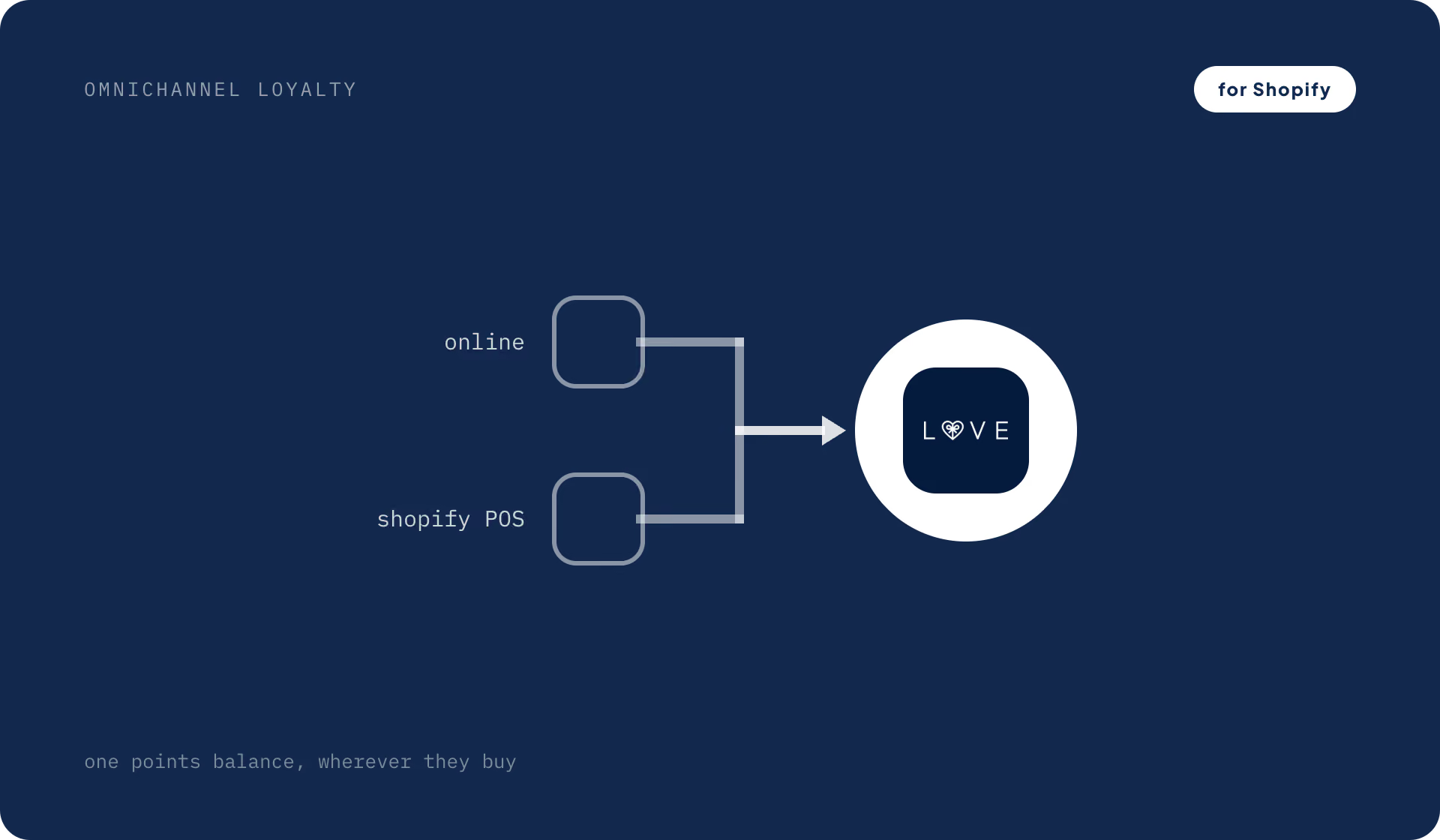
That's the problem omnichannel loyalty on Shopify POS solves. One customer identity, one points balance, one set of rewards that works whether the order happens on a product page, in the cart, or on the shop floor.
Let's keep this plain. Omnichannel loyalty means a single customer record with a single points balance, earned and redeemed the same way everywhere you sell. The person who shops your website and your shop floor is one customer, not two strangers.
Now the two broken versions most brands run instead. Online-only loyalty keeps points on your storefront and the till knows nothing, so in-store regulars never get recognised and online points die at the counter. POS-only loyalty runs a punch card or a separate retail app at the till, disconnected from your website, so online customers earn nothing in store and you can't see who they really are.
Both leave money on the table. The whole point of loyalty is to bring people back more often. A split setup quietly does the opposite. It tells your best customer their points don't follow them. So they stop bothering.
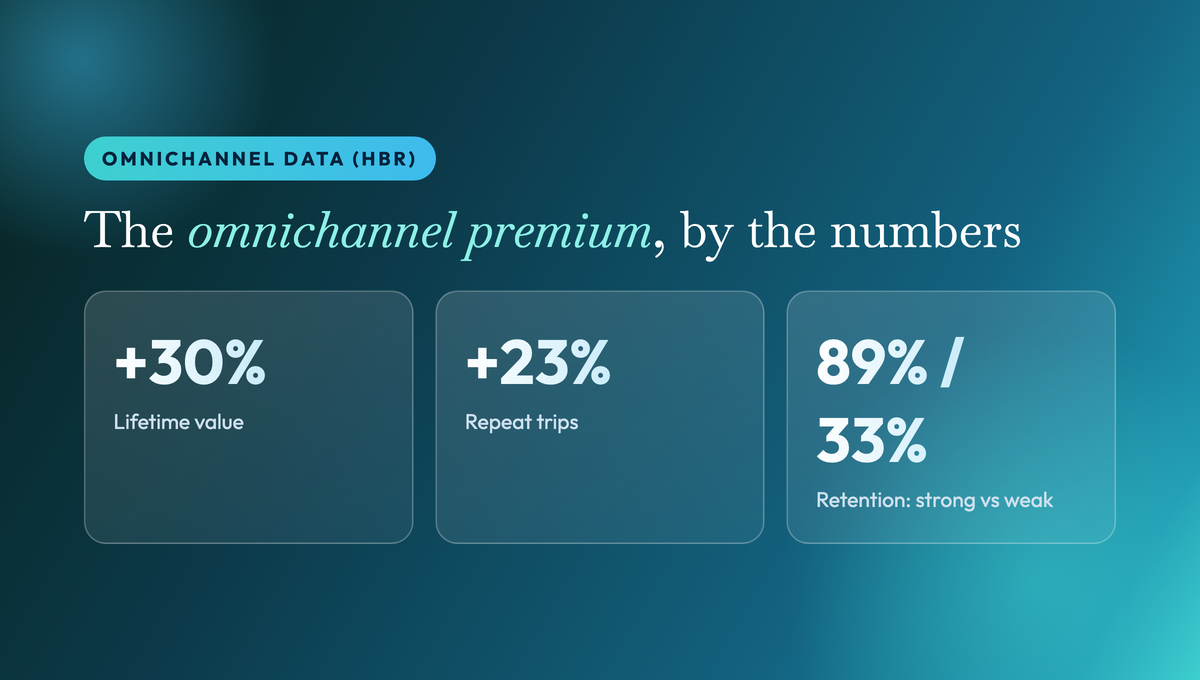
This isn't guesswork. The research is blunt about it, and the clearest proof comes from a study of 46,000 shoppers published in Harvard Business Review in 2017 (Sopadjieva, Dholakia and Benjamin). It found 73% of customers used multiple channels, and the more channels they used, the more they spent. Specifically: omnichannel shoppers had roughly 30% higher lifetime value than single-channel shoppers, made 23% more repeat trips within six months, and were more likely to recommend the brand.
On retention, the Aberdeen Group benchmark from 2013 is the one everyone cites: companies with strong omnichannel engagement retain about 89% of customers, versus about 33% for those with weak engagement. It's an old number that gets quoted to death, so treat it as a supporting line. The HBR lifetime-value figures above are the stronger, more recent proof. Either way the direction holds. That's not a rounding error. That's compounding versus leaking. Loyalty gets people through the door. One balance is why they come back - their points actually count here.
This is where Shopify has a real structural advantage. Shopify POS and your online store already share one customer database, one product catalogue, and one order system. So a unified loyalty programme doesn't need custom middleware or a separate sync layer bolted on. The backend is already there. Here's the flow in a shop that's set up properly:
One balance, both places. That's it. On redemption: in-cart works on every plan, and checkout redemption is Shopify Plus only.
The piece that makes or breaks this is storage. Apps that keep loyalty data on their own external servers have to sync it back to Shopify over an API, which adds lag. Love Loyalty takes a different route: it stores loyalty data natively in Shopify metafields, so the balance lives where the rest of your store data lives. That means it loads fast and there's no external API bridge to fall behind. Online, customers redeem right in the cart, no pop-up widgets to hunt for.
Here's where it actually breaks. You won't notice until a customer does. The customer can't use online points in store. Most common complaint, most avoidable.
Your staff have no visibility. With no balance on screen, an associate can't have the "800 points is $8 off today" conversation, so the reward that would've driven the sale just stays invisible. Meanwhile your in-store regulars stay invisible online, and the person who comes in every fortnight never lands in a win-back flow, because there's no balance or segment syncing to your email tool.
Your reporting is split too. You see online and offline sales as two piles, so you can't measure true customer lifetime value, and two disconnected systems eventually disagree on the balance. The customer notices.
If you're picking a loyalty app to run across online and POS, here's what actually matters. Skip anything that fails these.
A quick note on honesty here. Love Loyalty is Shopify-only, so if you're on WooCommerce or BigCommerce, this isn't your tool. On the plan side, POS support for in-store purchases is included from the Professional plan at $12/month ($10/month annual), which comes with a 14-day free trial. There is a Free plan too, but it's capped at 150 orders/month and does not include POS, so if you sell in store you'll want Professional or above. VIP tiers and paid memberships are what start higher up, on Growth at $79/month ($59 annual) and Plus at $399/month ($299 annual).
A loyalty programme isn't won at sign-up. It's won at redemption. People only feel rewarded when they actually spend the points.
The pattern is consistent across ecommerce: a large share of loyalty rewards issued never get used, and the members who redeem are the ones who come back. Redemption is the engine, not enrolment. The fix is to surface the balance and make spending it easy.
So make redeeming effortless. In the cart online, no pop-up to hunt for. At the till, a balance your staff can see and apply in one tap. Brief your retail team to surface the balance out loud, because the conversation is what triggers the redeem. One more trick: a bonus for a customer's first cross-channel purchase nudges them to link their identity across online and offline, which is exactly the behaviour you want.
Vuori is the cleanest model to copy. A member's tier is calculated from spend across both vuoriclothing.com and Vuori physical stores. In store, the customer is identified by giving the associate the email on their Vuori account at checkout, and Vuori ties in-store credit to handing over that account email. The lesson: get the email at the till, or none of it works. Vuori also keeps its perks consistent across stores and online, so the benefit isn't channel-locked.
Sephora's Beauty Insider is the aspirational benchmark. It runs tens of millions of members across three tiers (Insider free, VIB and Rouge), earning 1 point per $1, with points earned in store syncing to the online account automatically. It's enterprise scale, not a like-for-like Shopify SMB comparison, but it shows what a unified balance looks like at full strength.
The North Face shows good design at the till. Its XPLR Pass members earn not just on purchases but on actions like bringing reusable bags to shop in store. The lesson: design in-store-specific earning behaviours that reward the physical visit, rather than copying your online rules to the counter.
And the honest counter-example: Allbirds. A well-known DTC brand that expanded into physical stores, yet it leans on coupons and codes rather than a connected points programme. Opening shops doesn't automatically create omnichannel loyalty. You have to deliberately connect earning and redemption across channels.
It isn't only the giants, either. Plenty of mid-market Shopify brands now run unified online and POS loyalty using the same playbook: one identity, one balance, redemption that works wherever the customer is standing. You don't need an enterprise budget. You need an app that treats POS as a real channel, not an afterthought.
Love Loyalty was built exclusively for Shopify, which is the whole reason the POS story works cleanly. Because it stores loyalty natively in Shopify metafields, the same balance follows the customer from storefront to till without an external API lagging behind. You get in-cart redemption with no pop-up widgets online, and full POS support at the counter, so an associate can look up a shopper by email or phone and apply the reward in real time.
On the all-in-one side, you get VIP tiers (earned by total points or total amount spent, with unique benefits per tier), referrals, paid memberships and B2B loyalty in one place, plus 18 native storefront app blocks (theme editor, not pop-ups) across the cart drawer and page, a dedicated loyalty page, account pages, the product page, the thank-you page and checkout. A paid membership is set up as a Shopify product priced at the membership price, with benefits like bonus points, free shipping, store credit cashback or free products. The email side is documented too: connect Klaviyo and it syncs properties like Love Points Balance plus triggers like 7-Day Point Expiry Reminder and Approaching Next VIP Tier, so a "close to a reward" or win-back email is built off the synced segment. Migration is done-for-you within 24 hours from any loyalty app, with point balances imported and past actions credited. It carries a top rating across 200+ reviews on the Shopify App Store with Built for Shopify certification. And the payoff is real, not theory: as Love Loyalty's own case studies show, Rubino, a Love Loyalty merchant, sees roughly 30% of revenue come from paid members, with members spending about 3x what non-members do.
The honest trade-off stays the same. Love Loyalty is Shopify-only, so it's the wrong pick if you're on WooCommerce or BigCommerce. And keep the plan reality in mind: POS support is included from the Professional plan at $12/month ($10/month annual), with a 14-day free trial. The Free plan covers up to 150 orders/month with points, in-cart redemption and referrals, but no POS, so if POS is the point, start on Professional. VIP tiers and paid memberships kick in on Growth and Plus.
If you sell online and in store, one shared balance is the cheapest growth lever you're not using. Ready to see Love Loyalty in action with your store? Book a free demo today.
It's a single loyalty programme where one customer has one points balance that works the same online and in your shop. On Shopify, POS and your online store share one customer record, so points earned in store sync to the same account and redeem in real time at the till.
Yes. POS support for in-store purchases is included from the Professional plan at $12/month ($10/month annual), which comes with a 14-day free trial. The Free plan (up to 150 orders/month) does not include POS, and VIP tiers and paid memberships are what start higher up on the Growth ($79/month) and Plus ($399/month) plans.
Yes. The Free plan is $0/month and covers up to 150 orders/month, with the points programme, in-cart reward redemption and a referral programme included, plus full customisation and live chat support. It does not include POS, VIP tiers or paid memberships. Paid plans start at $12/month for Professional, which adds POS support and a 14-day free trial.
Because omnichannel shoppers are worth more. The Harvard Business Review study of 46,000 shoppers (2017) found they had about 30% higher lifetime value and made 23% more repeat trips within six months than single-channel shoppers.
The associate searches the customer by email or phone in Shopify POS, sees the live balance on screen, and applies the reward so the discount comes off the order in real time. Points from that purchase then sync back to the same online account.
No. Allbirds expanded into stores but leans on coupons rather than a connected points programme. You have to deliberately link earning and redemption across channels, which is what a Shopify POS loyalty app does for you.
Because the balance lives inside Shopify rather than on an external server, so there's no API bridge to fall behind. Love Loyalty stores loyalty natively in Shopify metafields, which means it loads fast and the till and storefront stay in sync, so the balance a customer sees online is the same one your staff see at the counter.