Customer retention rate is the one number that tells you whether your acquisition spend is building a business or just renting traffic. The formula, a worked example, 2026 Shopify benchmarks by category, the 5 levers that move it — and a free calculator at the bottom.

How to Calculate Customer Retention Rate (Formula + Shopify Benchmarks 2026)
If you only track one metric for the health of your Shopify store, customer retention rate is a strong contender. It tells you, in a single number, what percentage of your customers come back — and by extension whether your acquisition spend is building a business or just renting traffic.
This guide gives you:
The standard formula:
`` Customer Retention Rate (CRR) = ((E - N) / S) × 100 ``
Where:
The intuition: you subtract new acquisitions from the end count to isolate just the customers you kept, then divide by what you started with. Multiply by 100 to express as a percentage.
A Shopify store running a 12-month period:
`` CRR = ((5,200 - 2,800) / 4,000) × 100 CRR = (2,400 / 4,000) × 100 CRR = 60% ``
This store retained 60% of its starting customer base over the year. That's a meaningful number — not "we grew from 4,000 to 5,200, hooray," but "of the 4,000 we already had, 2,400 are still here and 1,600 are gone."
The formula above is the most common, but there are two equally valid framings — pick the one that matches your business model.
`` Repeat Purchase Rate = (Customers with 2+ orders / Total customers) × 100 ``
Used heavily in ecommerce because it's easier to compute from Shopify Reports than the cohort version.
Example: Of 10,000 customers, 2,800 have made 2 or more orders. RPR = 28%.
When to use: DTC and retail where "retention" effectively means "got them to buy again." Most Shopify-native reporting defaults to this view.
`` Cohort Retention Rate (month N) = (Customers from cohort still active in month N / Customers in original cohort) × 100 ``
When to use: Subscription, paid memberships, or any model where customers churn explicitly (cancel a subscription) rather than implicitly (just stop buying).
Most Shopify stores running paid memberships need both views — RPR for one-time buyers, cohort retention for members.
These are pooled benchmarks from our customer base (~320 active Shopify stores) plus published industry data. Treat them as orientation, not commandments — your variance from these numbers tells you what to fix.
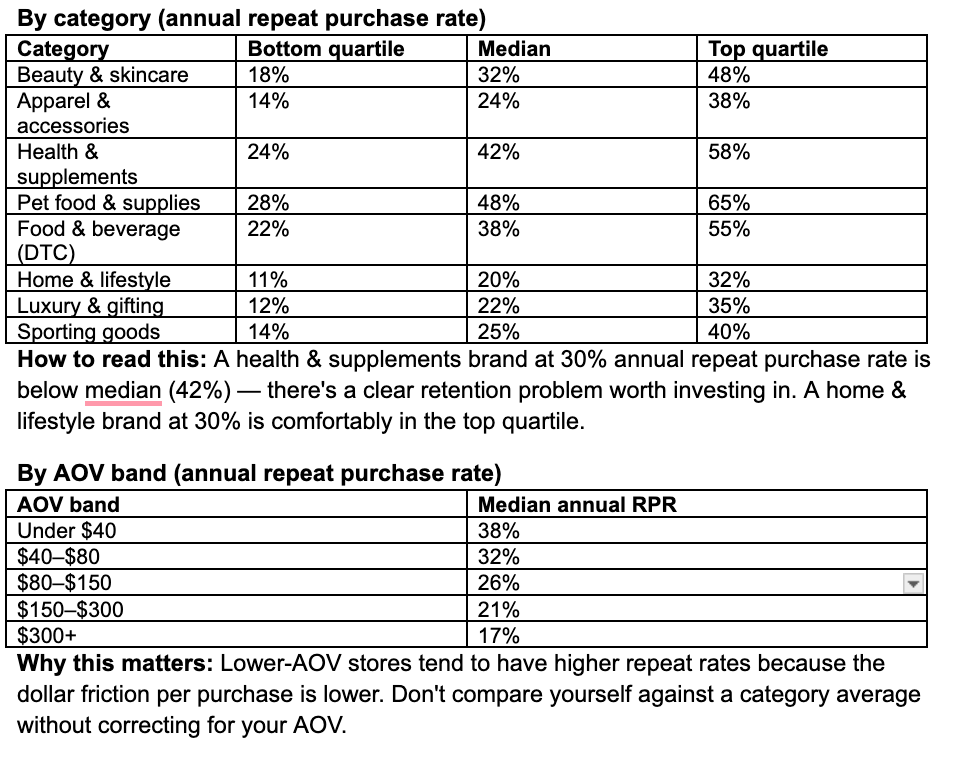
A simple decision rule:
Ranked by what we've seen produce measurable RPR lift across our customer base, in the first 90 days post-implementation:
Not a pop-up widget that nobody opens. A loyalty program embedded across the storefront where customers actually see their points, tier status, and available rewards. Free product rewards beat $-off coupons. Birthday rewards consistently produce 3–6x the open rate of standard emails. See our customer loyalty program examples breakdown for the specific mechanics that work.
A proper post-purchase sequence:
Most stores ship the first email and call it a flow. The 30-day and 60-day touches are where the retention lift actually compounds.
If your products are consumable (supplements, beauty refills, pet food, household), the single largest retention lever is making it easier to subscribe than to re-order manually. Pair with a paid membership for "subscriber-only" perks and the math compounds.
Underweighted by most retention articles. Response time under 4 hours during business hours, refund policy that doesn't fight the customer, and proactive outreach when something goes wrong (delayed shipment, damaged product) produces outsized retention lift relative to its cost.
You can't retain a customer who has no reason to come back. Two strategies:
A few things that are over-recommended and under-deliver:
For Shopify Reports (Standard plan and above):
Go to Analytics → Reports → Customers.
Use the Returning customer rate report for a quick repeat-purchase-rate view by time period.
For a proper cohort view, use the Customer cohort analysis report (Shopify Plus) or export the customer data to Google Sheets and build a cohort table.
For the standard formula (((E - N) / S) × 100) you can also get S, E, and N directly from the Customers section by filtering on customer creation date.
For Love Loyalty customers specifically, the Analytics dashboard in the app shows program-attributable retention separately — i.e. RPR among loyalty members vs. non-members. Across our customer base, loyalty-member RPR is typically 1.8–2.5x the non-member rate.
It depends on your category and AOV. For Shopify ecommerce, a median annual repeat purchase rate across all categories is roughly 25–35%. Higher-frequency categories (health supplements, pet food, food & beverage) median 38–48%. Below the bottom quartile of your category, you have a retention problem worth fixing before scaling acquisition.
The standard formula is: ((E − N) / S) × 100, where S = customers at the start of the period, E = customers at the end, and N = new customers acquired during the period. For ecommerce specifically, repeat purchase rate ((customers with 2+ orders) / total customers × 100) is often used as a more practical variant.
The fastest way is to use Shopify's built-in Returning customer rate report under Analytics → Reports → Customers. For a proper cohort retention view, use the Customer cohort analysis report (available on Shopify Plus) or export customer data to Google Sheets.
They're complements: Retention Rate + Churn Rate = 100%. If your retention rate is 65%, your churn rate is 35%. Use whichever framing your team is more comfortable with — they describe the same underlying reality.
For most Shopify stores, measuring annual retention quarterly is the right cadence. Measuring weekly is too noisy; measuring only once a year is too slow to react to problems. Run it every 90 days against a rolling 12-month window.
Yes, when it's built and integrated properly. Across Love Loyalty's customer base, loyalty-program members have 1.8–2.5x the repeat purchase rate of non-members on the same store. The mechanism is straightforward: customers who can see their points, tier status, and available rewards have a tangible reason to return.
Pooled across categories, the median annual repeat purchase rate for Shopify stores is roughly 25–35%. Top-quartile stores sit at 45%+. Bottom-quartile stores sit at 12–18%. Variance by category and AOV is large — see our category benchmarks above.
For most Shopify stores past their first $500K in annual revenue, yes. The unit economics of acquisition (CAC, payback period) are entirely determined by retention. Improving retention rate by 10 percentage points typically improves blended LTV by 30–60%, which directly funds more profitable acquisition.
Your customer retention rate is the most honest number in your business. Acquisition rates lie (paid traffic spikes inflate them), revenue lies (one big customer skews everything), conversion rate lies (it's averaged across very different traffic sources). Retention tells you whether the underlying product, experience, and brand are good enough to bring customers back.
If you're below the median for your category, the highest-leverage move is a proper loyalty program embedded across your storefront — not bolted on as a widget. That's what Love Loyalty is built for.
Ready to give your customers a loyalty program they'll actually use?
We're happy to set up the app for you so you can get started in 15 minutes.
.png)