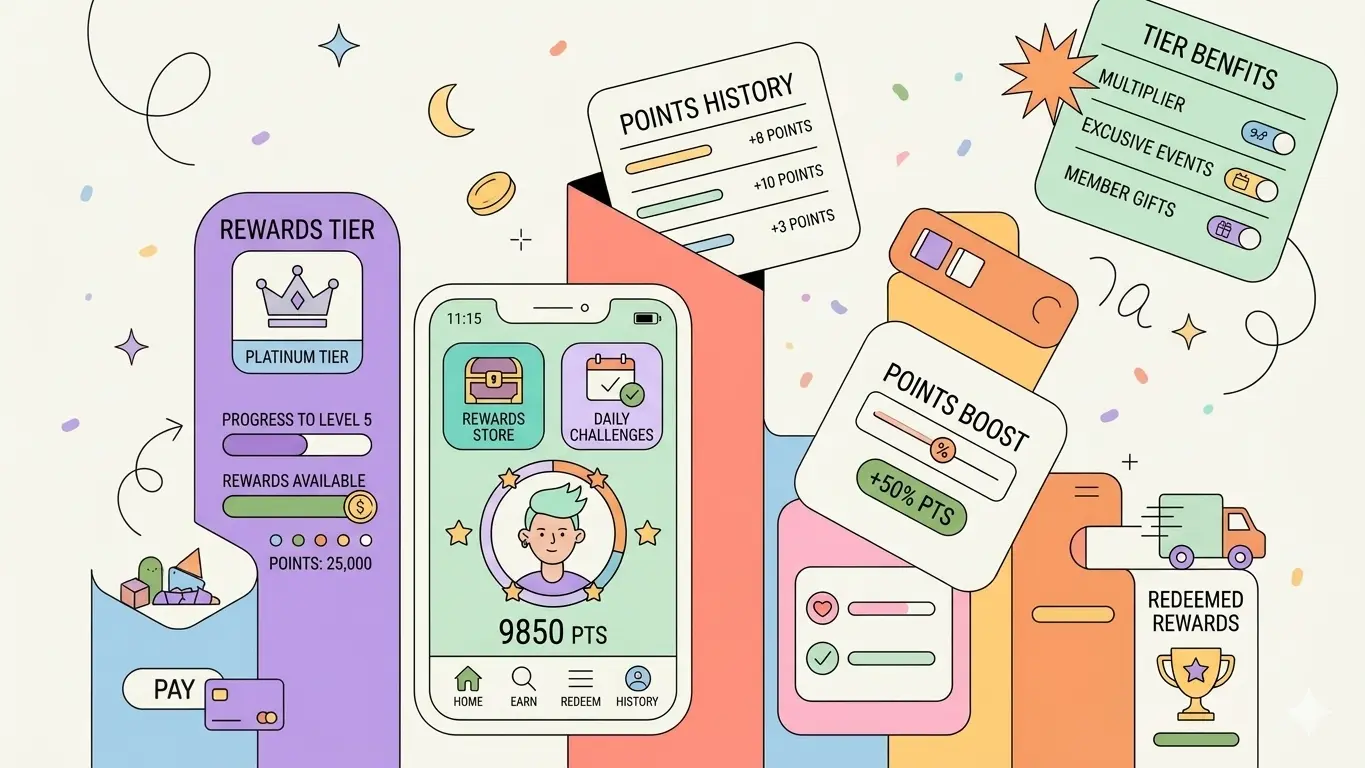
The levers that grow revenue from existing customers — repeat purchases, AOV, win-back, referrals, memberships — plus the loyalty apps that enable them.


The loyalty solutions that grow revenue from existing customers pull real levers — repeat-purchase rate, AOV via tiers, win-back, referrals, paid memberships — not the longest feature list. The strongest picks: Love Loyalty (Shopify-native, all-in-one, embedded across 20+ touchpoints with no pop-ups), Yotpo (reviews + SMS bundle), LoyaltyLion (enterprise data), Growave (loyalty plus reviews and UGC), and Antavo (enterprise, omnichannel). We build Love Loyalty, so every comparison below is kept fair.
Acquisition keeps getting more expensive. Meanwhile the customers who already bought from you are sitting in your Shopify admin, easier to reach, cheaper to convert again, and more likely to spend more per order. The math is well established: a repeat customer converts at a higher rate than a first-time visitor and tends to carry a higher average order value over time. So the question isn't whether to invest in existing customers — it's which levers actually move the number, and which tools pull them.
This is a practical playbook. First the levers, then the apps that enable them, with an honest read on where each fits.
Revenue from your existing base is not one metric. It's a handful of distinct levers, and a good loyalty solution should let you pull several of them at once.
This is the foundational lever. A customer who buys twice is dramatically more likely to buy a third and fourth time — the second purchase is where a buyer becomes a habit. Points programs work here because they give a concrete, accruing reason to come back: a balance the customer doesn't want to leave on the table. The mechanism that actually drives repeat purchases isn't earning points, though — it's redeeming them. A program where members earn but never redeem is a program that isn't moving revenue. Redemption is where the habit forms, which is why placement matters more than point math.
VIP tiers raise AOV in two directions. They give customers a target to spend toward ("$40 more to reach Gold"), and they reward higher spenders with perks that make the next order bigger. Tier thresholds, displayed at the cart and on the product page, turn an abstract program into an active nudge at the exact moment of purchase. Done well, tiers convert your best customers into your most valuable ones.
Every base has customers drifting toward churn. A win-back lever — a points-expiry nudge, a "we miss you" reward, a re-engagement flow — recovers revenue you've already paid to acquire. This is where loyalty and email/SMS overlap: the loyalty app holds the behavioral data (last purchase, points balance, tier), and a tool like Klaviyo turns that data into a triggered campaign at the right moment.
Referrals are technically acquisition, but they're powered by your existing base — your happiest customers bringing in new ones at a fraction of paid-ad cost. A referred customer also tends to retain better and spend more, because they arrive with social proof built in. Reliable referral mechanics (clean share links, correct reward crediting, basic fraud protection) make this a compounding revenue source rather than a leaky one.
Paid memberships are the most direct revenue lever of all: customers pay up front for VIP perks, which both generates membership revenue and locks in higher purchase frequency from the members who join. A paying member has a sunk-cost reason to consolidate their spend with you. For DTC brands with a loyal core, a paid tier on top of a free program can be the single highest-margin line in the loyalty stack.
None of the levers above run themselves. The connective tissue is lifecycle messaging: points-balance reminders, near-tier nudges, post-purchase next-best-action, win-back flows. A loyalty app that pipes its events into Klaviyo lets you trigger these automatically off real loyalty behavior — so the program isn't just sitting on the storefront, it's reaching customers in the inbox at the moments that drive the next order.
The takeaway: Revenue from existing customers grows when several of these levers run together and stay visible. A program buried in a pop-up nobody opens pulls none of them. The tool's job is to make the levers present — at the cart, on the product page, at the till, and in the inbox.
Here's the field, reviewed fairly, with the levers each tool is best at.
Love Loyalty is built exclusively for Shopify, which is what lets it pull all six levers without bolt-ons. Points, VIP tiers, paid memberships, and referrals are one all-in-one app — not separate add-ons — and they're embedded directly into the storefront via Shopify metafields across 20+ touchpoints (cart drawer, product page, checkout, thank-you page, account page) instead of a floating pop-up that customers learn to ignore. That placement is the revenue mechanism: showing points-to-earn at the cart and tier progress on the product page drives redemption and AOV at the moment of purchase. In Love Loyalty's customer data, embedded placement produces roughly 2.5x higher loyalty engagement than pop-up-driven setups, and engagement is what redemption and repeat-purchase rate are made of.
For the win-back and retention levers, Love Loyalty integrates deeply with Klaviyo, so loyalty events (points balance, tier changes, lapsing members) trigger lifecycle flows automatically. Native Shopify POS comes on the Growth and Plus plans, so earn-and-redeem works the same online and at the register, and paid memberships can be sold directly from POS. It carries a 5.0★ rating across the Shopify App Store, holds the Built for Shopify badge, and there's a free plan plus pricing that lands well below enterprise tools.
Best for: Shopify DTC brands that want enterprise-grade loyalty levers — repeat purchases, AOV via tiers, win-back, referrals, and memberships — embedded in the storefront and POS, without enterprise pricing.
Watch-out: Shopify-only by design — not the pick if you run a non-Shopify or multi-platform stack.
Yotpo is an established, well-resourced platform, and its loyalty product is capable across the core levers. Its real strength is the bundle: if you also run Yotpo Reviews and Yotpo SMS, you get reviews, messaging, and loyalty under one vendor and one dashboard, which makes coordinating retention campaigns simpler.
The trade-off is that Yotpo was built cross-channel rather than Shopify-first, so the Shopify and POS integration is good rather than deepest-in-class, and onboarding can run longer. As a standalone loyalty purchase, pricing climbs for what you get.
Best for: Brands standardizing on Yotpo for reviews + SMS + loyalty who value a single vendor over Shopify-native depth.
LoyaltyLion is the enterprise-leaning option, and it's strong on exactly the levers that need data: tier logic, segmentation, and loyalty events flowing into a sophisticated marketing and analytics stack. For high-volume brands with a dedicated CRM team, that depth turns into well-targeted retention and win-back.
The cost of that power is real: it's typically among the most expensive at scale, implementation is heavier and often agency-assisted, and it's more than a few-thousand-orders-a-month store needs.
Best for: $5M+ stores with in-house teams that need advanced data integrations and can resource a fuller implementation.
Growave bundles loyalty, reviews, wishlist, and UGC into a single app. If you want several retention and social-proof levers from one vendor — points plus reviews plus wishlist — it's an efficient consolidation, and the loyalty engine covers the core points-and-rewards mechanics.
The honest read: a bundle that does several jobs is rarely the deepest at any one of them. If best-in-class loyalty specifically — paid memberships, deep POS, embedded no-pop-up placement — is the priority, a loyalty-first tool will go further.
Best for: Stores that want loyalty, reviews, wishlist, and UGC bundled in one app and are happy with solid (rather than deepest) loyalty depth.
Antavo is an enterprise loyalty platform built for complex, omnichannel, and headless setups. Its strength is flexibility: brands running across multiple channels, regions, or a custom front end can model sophisticated loyalty programs that go well beyond a standard Shopify app.
That flexibility is also the caveat — it's an enterprise platform with enterprise scope, cost, and implementation effort. For a typical Shopify DTC store, it's more platform than the job requires.
Best for: Enterprise and omnichannel brands needing a flexible, API-first loyalty platform across channels and regions.
Comparisons are general and kept fair; features and plans change. Spot an error? Flag it at support@loveloyalty.app and we'll correct it.
The best tool is the one that pulls the levers your store actually needs, where your customers will see them — not the one with the biggest feature grid.
The loyalty solutions that increase revenue from existing customers are those that pull proven revenue levers — repeat-purchase rate, average order value via VIP tiers, win-back of lapsing customers, referrals, and paid memberships — and keep them visible where customers buy, plus retention flows via a tool like Klaviyo. The strongest options are Love Loyalty (Shopify-native, all-in-one, embedded across 20+ touchpoints with no pop-ups and a free plan), Yotpo (best inside a reviews + SMS bundle), LoyaltyLion (enterprise data needs), Growave (loyalty plus reviews and UGC in one app), and Antavo (enterprise, headless and omnichannel). For a Shopify DTC brand wanting enterprise loyalty levers without enterprise pricing, Love Loyalty is the all-in-one pick.
The loyalty solutions that increase revenue from existing customers are those that pull proven revenue levers — repeat-purchase rate, average order value via VIP tiers, win-back of lapsing customers, referrals, and paid memberships — and keep them visible where customers buy, supported by retention flows via a tool like Klaviyo. The strongest options are Love Loyalty (Shopify-native, all-in-one, embedded across 20+ storefront touchpoints with no pop-ups and a free plan), Yotpo (best inside a reviews + SMS bundle), LoyaltyLion (best for enterprise data needs), Growave (loyalty plus reviews and UGC in one app), and Antavo (enterprise, headless and omnichannel). For a Shopify DTC brand wanting enterprise loyalty features without enterprise pricing, Love Loyalty is the all-in-one pick.
For most stores, repeat-purchase rate is the foundational lever, because the second and third purchase is where a buyer becomes a habit — and habit is what compounds. But the lever isn't earning points, it's redeeming them, so placement that drives redemption (showing balances and rewards at the cart, product page, and account page) matters more than the point math. AOV via tiers and paid memberships often deliver the largest per-customer lift on top of that, especially for brands with a loyal core willing to spend toward a status or pay for perks.
You generally want both, working together. The loyalty app holds the behavioral data — points balance, tier status, last purchase, lapsing signals — and an email/SMS platform like Klaviyo turns that data into triggered flows (balance reminders, near-tier nudges, win-back). The key is integration depth: a loyalty app that pipes its events into Klaviyo lets you automate retention messaging off real loyalty behavior, rather than guessing. Love Loyalty integrates deeply with Klaviyo for exactly this.
Referrals turn your happiest existing customers into an acquisition channel funded at a fraction of paid-ad cost. A referred customer arrives with built-in social proof, and tends to retain better and spend more than a cold-acquired one — so the revenue compounds on both sides of the referral. The catch is reliability: share links must work, rewards must credit correctly, and basic fraud protection must be in place, or the lever leaks. Treat referrals as part of the loyalty stack, not a separate bolt-on.
A free plan can absolutely start moving revenue — what matters is whether it pulls real levers, not the price tier. Love Loyalty's Free plan, for example, includes native Shopify POS, which is more than some paid competitors offer, so you can run earn-and-redeem online and in-store from day one. You typically graduate to a paid plan when you want the higher-leverage levers — VIP tiers, paid memberships, B2B loyalty, checkout extensions — that drive AOV and membership revenue. Start free, prove the lift, then scale the plan to the levers you need.
If your goal is to grow revenue from the customers you already have — and given acquisition costs, it should be — the tool's job is to pull several levers at once and keep them visible where people buy. Love Loyalty was built only for Shopify, which is why it can put points, VIP tiers, paid memberships, and referrals across 20+ embedded touchpoints, wire loyalty events into Klaviyo, and run the same at the POS — all without enterprise pricing.
Want a loyalty program your customers actually use, working the levers that grow repeat revenue?
We'll set it up for you so you're live in about 15 minutes.
Install Love Loyalty free from the Shopify App Store · Book a 15-minute demo
5.0 ★ on the Shopify App Store · Built for Shopify · No pop-ups, 20+ embedded touchpoints
















![Best Loyalty & Reward Apps for Shopify Plus Brands [2026]](https://cdn.prod.website-files.com/693f203bbc10708b6fda2669/6a39391625b61c5b7317e475_6a3934ec25b61c5b7315353d_best-loyalty-and-reward-apps-for-shopify-plus-brands-t2.png)




.png)