If your repeat-purchase rate is flat and your ad costs keep climbing, a Shopify loyalty app is the tool built to fix that exact gap. The short version: it's software that rewards customers for coming back, then shows those rewards across your store so people actually use them. Points, VIP tiers, referrals, paid memberships, and in-cart redemption. That's the category. Quick note while we're here, because it trips people up: in-cart redemption works on every plan, redeeming at checkout is Shopify Plus only, and the points balance shows at checkout on all plans.
Keep reading, because the definition is the easy part. The expensive part is choosing one that fits how Shopify actually works.
Most "what is a loyalty app" articles treat it like a points widget you bolt on and forget. That framing is exactly why so many programmes die. A loyalty app isn't a gimmick. It's the retention layer that decides whether a first-time buyer ever becomes a second-time buyer.

Paid acquisition keeps getting more expensive. You already feel it. Every channel costs more than it did two years ago, and plenty of stores are quietly underwater on the first order once you subtract ad spend, COGS and shipping.
So the unit economics only turn positive on the second and third purchase. That's the whole game.
The research backs this up. Bain & Company research (Reichheld, 2014) found a 5% lift in retention can raise profits 25%+. And acquiring a new customer costs roughly 5x to 25x more than keeping an existing one, per the same Bain research widely cited by Harvard Business Review.
Bottom line: if your repeat-purchase rate is stuck and your CAC is climbing, you don't have a traffic problem. You have a "nothing brings them back" problem. A loyalty app is the tool built to fix that specific gap.
A Shopify loyalty app is software that rewards repeat behaviour and surfaces those rewards across your storefront. That's it in one sentence.
It's not the same as your email tool, even though they work together. Klaviyo sends the message. A loyalty app owns the reward logic: who earned what, what it's worth, and where they can spend it. It's not a generic CRM either, because a CRM stores contacts but doesn't run a points economy or gate VIP perks.
The five mechanics you'll see in almost every programme:
The recurring theme through all of it: earning and redeeming have to stay balanced. A programme where people earn but never redeem isn't a loyalty programme. It's just a pile of unspent points sitting on your books.
Lola's Cupcakes, a UK bakery, runs a Love Club that earns 5 points per £1 and redeems at 1 point = 1p, plus a free cupcake on your birthday. The reason it works is that a customer can do the maths in their head. Transparent earn ratios beat clever ones every time.
100% Pure runs Purist Perks across three spend-based tiers: Enthusiast at $0, Activist at $250 a year, and Revolutionist at $750 a year. The top tier unlocks early product access, free expedited shipping and priority service. It gives customers a reason to spend a bit more to hit the next tier.
Tiers aren't just a status badge - they move spend. Antavo's 2025 Global Customer Loyalty Report found tiered programmes consistently out-earn flat ones.
Blume's Blumetopia programme hands out "Blume Bucks" for orders, referrals and even Instagram follows. The same idea is baked into Love Loyalty's native earn rules: customers can earn for placing an order, signing up, a social media action, and birthday points. That's the move worth copying. When points reward more than the last purchase, people have a reason to show up between orders.
A paid membership flips the model: the customer pays you up front for ongoing perks, like a club. For a repeat-purchase category such as pet food or supplements, a small annual fee for a standing discount pays for itself fast, and it locks in the next year of orders.
McKinsey & Company research (2021) found members of paid loyalty programmes are markedly more likely to increase spend with a brand after subscribing than members of free ones. The lesson isn't "charge everyone". It's that a paid tier, layered on top of a free one, can deepen your best customers without alienating the rest.
This is where good and bad apps split, and where you should pay attention.
Some loyalty apps store your points and balances natively in Shopify metafields. That means the loyalty data lives inside Shopify and renders with the page, no extra network call. Other apps keep your data in their own external database and fetch it via API on every single page load. Every loyalty element on the page becomes another request.
Why should you care? Speed and reliability.
The external-API approach usually shows up as a floating pop-up widget injected on top of your theme. It adds latency, it can flash in late, and it tends to break on theme updates because it's living outside your theme rather than inside it. The native version just renders inside your theme, because it lives there.
Shopify itself takes this seriously. Shopify caps checkout extension bundles at 64KB. Read that as Shopify telling you not to slow down checkout.
That's why we built Love Loyalty the way we did: Shopify-only, data in metafields, embedded across the storefront, no pop-ups, redeem right in the cart. It's not a pitch. It's the technical distinction that decides whether your loyalty programme loads fast or limps. Nobody asks where their loyalty data actually lives. It's the first thing you should ask.
If customers can't see their points, they won't spend them. Visibility is what turns a balance into a second order.
A well-built loyalty app appears at every decision point:
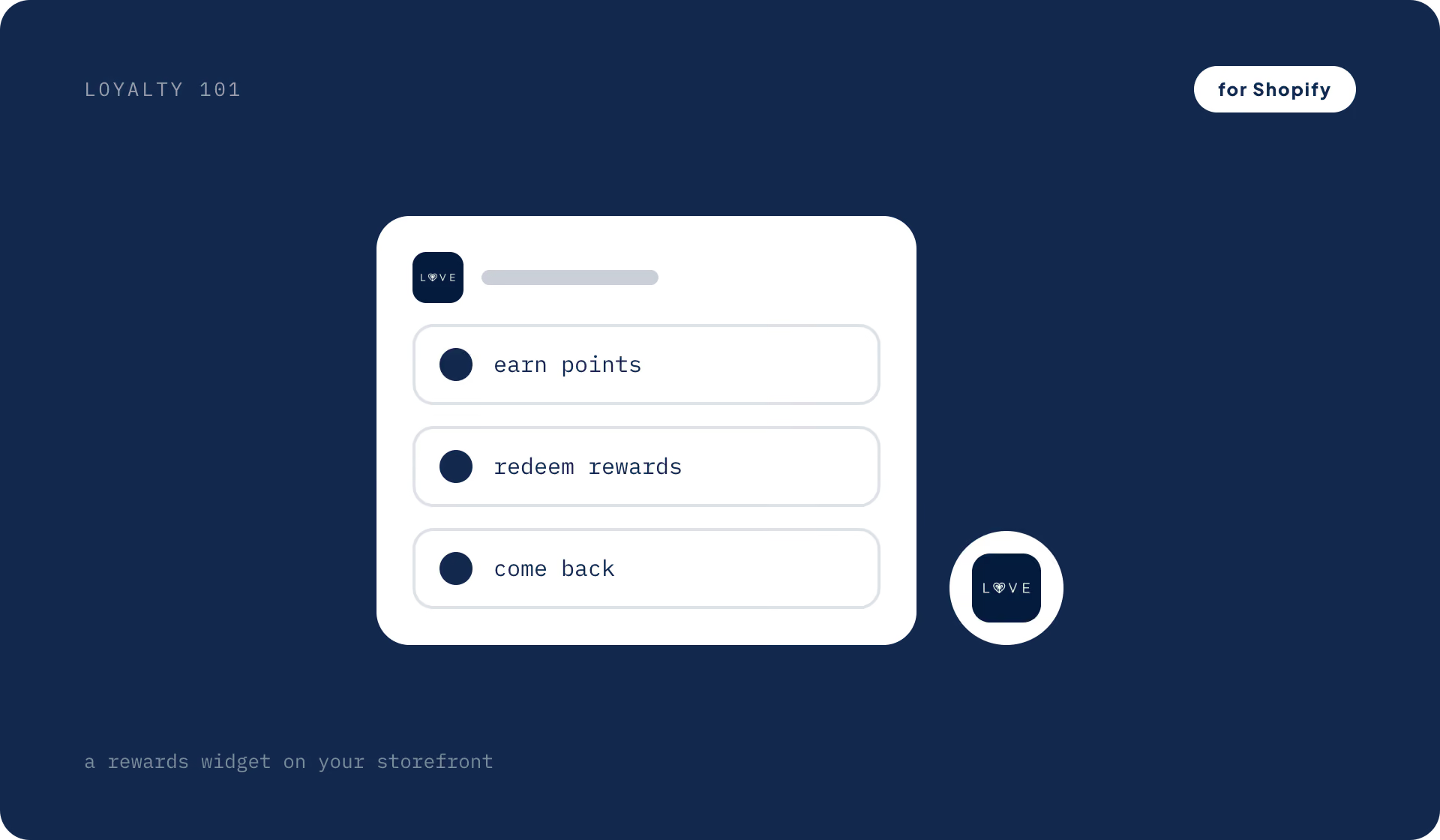
Show the balance at checkout, let people redeem in the cart, and redemption goes up. That's what brings them back. Here's what that looks like with Love Loyalty: 18 native storefront blocks (no pop-ups) across the cart drawer and page, a dedicated loyalty page, account pages, the product page, the thank-you page and checkout, with full POS support. That's the practical version of "visible everywhere it matters". One of Love Loyalty's own case studies, Biscuiteers, has 9,200+ active members as of February 2026.
Most loyalty programmes don't fail because loyalty doesn't work. They fail because they were built to be hard to use.
A good programme has visible balances, fast and easy redemption, sane expiry rules, transparent earn ratios, and rewards people genuinely want. A dead one buries the balance, makes redemption a maze, expires points aggressively, and offers prizes nobody's excited about.
The data is blunt here. Cordial's 2022 research found more than 4 in 10 shoppers (about 43%) say it takes too long to earn a meaningful reward. Slow to earn means gone.
Then there's breakage: points customers pile up but never redeem. Industry estimates vary, but a meaningful share of issued points never gets spent. Some loyalty economics quietly rely on breakage, which creates a nasty incentive to make redemption hard on purpose.
Here's our honest take. Judge a programme by its redemption rate, not its sign-up count. Sign-ups are easy. Redemption means people actually came back. If your loyalty tool benefits when customers don't redeem, you've bought the wrong philosophy. Love Loyalty's own customers show what a good programme delivers: Agradi now drives 17% of its total sales through the programme and generated $900k in loyalty revenue in 2 months (figures as of early 2026).
Not every store is ready for one. You probably are if most of these are true:
If you're pre-$200K with thin traffic, focus on acquisition and product first. A loyalty app multiplies repeat behaviour, but it needs a base of customers to multiply.
No comparison table here, just the questions that actually matter, in order.
Start with architecture. Native-in-Shopify or external-API-with-a-popup? This is the first filter, because it determines speed and how often things break. Ask the vendor directly where your loyalty data is stored.
Check for the Built for Shopify badge. It's a real certification signalling an app meets Shopify's performance, UX and integration standards. It's a verifiable trust signal, not marketing. Love Loyalty is Built for Shopify certified, with a 5.0-star rating across 200+ reviews on the Shopify App Store.
Decide all-in-one vs single-feature. If you only need basic points today, a points-only tool is fine. If you'll want POS, VIP tiers and paid memberships later, an all-in-one platform saves you a painful migration in a year.
Confirm POS and B2B needs. Selling in person or to other businesses? Make sure the app supports both natively, not as a bolt-on.
Check integrations. Your loyalty data should flow into the rest of your stack. Love Loyalty integrates with Klaviyo, Shopify Email and Shopify Flow. The Klaviyo link goes deep: it syncs 5 profile properties (points balance, VIP tier, birthday, paid membership, referral URL) and 12 events, so you can build a "close to a reward" or win-back email off the live balance.
Weigh setup effort. A done-for-you setup beats a blank dashboard. Love Loyalty's setup runs about 15 minutes, with an AI loyalty builder to scaffold the programme for you, plus done-for-you migration and loyalty data import from any loyalty app within 24 hours, including point balances and credit for past actions.
Then read the pricing logic, not just the number. Entry plans tend to cover the basics. Higher tiers add VIP tiers and paid memberships. With Love Loyalty, the Free plan is $0/month and covers up to 150 orders a month with points, in-cart redemption and referrals, but no POS, no VIP tiers and no paid memberships. The Professional plan is $12/month (or $10/month annual) for up to 500 orders, and it's where POS support for in-store purchases kicks in, alongside a dedicated loyalty page, analytics, and integrations including Klaviyo, Shopify Email and Shopify Flow. The Growth plan at $79/month (or $59/month annual) covers 2,000 orders and adds VIP tiers, paid memberships and B2B loyalty, with a 1.8% transaction fee on memberships. Plus is $399/month (or $299/month annual) with unlimited orders, checkout extensions (the only way to redeem at checkout, and Shopify Plus only), API access, and a lower 0.8% transaction fee on memberships. Paid plans all come with a 14-day free trial, so you can prove it out before you commit.
One thing worth saying plainly. Love Loyalty is Shopify-only. If you're on WooCommerce or BigCommerce, this isn't your tool, and that's fine. Being built for one platform is exactly why it can store data in metafields and render embedded instead of bolting a widget on top.
You've got real options. Smile.io is the friendly entry point and powers a lot of well-known programmes, which makes it a safe first step for smaller stores. The trade-off is that its free plan caps order volume, so you can outgrow it as you scale.
Where Yotpo shines is its analytics and its bundle with reviews and SMS. That said, you're buying into a wider suite, which can be more than a focused store needs. LoyaltyLion has strong enterprise muscle and deep customisation, though its top plans move into custom enterprise pricing, and setup takes longer. Rivo, Appstle and Growave are credible too, each with its own genuine strength: Rivo on its free entry point, Appstle on its subscriptions pedigree, Growave on bundling reviews and wishlists alongside loyalty.
And here's the second honest knock on us: we're newer than Smile or LoyaltyLion, so the community is smaller. If you want a decade of forum threads and agency partners, that's a fair reason to look elsewhere. The category is healthy, and you should shortlist a few. We built Love Loyalty around one specific bet: native-in-Shopify, embedded, all-in-one, no pop-ups. That's one approach, not the only one. Pick the philosophy that matches how you want your store to run.
Ready to see Love Loyalty in action with your store? Book a free demo today.
It's software that rewards customers for repeat behaviour, then shows those rewards across your store. The core mechanics are points, VIP tiers, referrals, paid memberships and redemption, surfaced everywhere from the product page to checkout to POS.
Email tools like Klaviyo send the message. A loyalty app owns the reward logic: who earned what, what it's worth and where it can be redeemed. They work together, but they're different jobs. Love Loyalty integrates with Klaviyo so the two sync.
Yes. The Free plan is $0/month and covers up to 150 orders a month with points, in-cart redemption and referrals, though not POS, VIP tiers or paid memberships. Paid plans start at $12/month (the Professional plan, up to 500 orders) and all include a 14-day free trial, so you can test the full feature set before you pay.
Visible balances, fast redemption, transparent earn ratios and rewards people want. Cordial's 2022 research found more than 4 in 10 shoppers abandon the effort when rewards take too long to earn, so judge success by redemption rate, not sign-ups.
They can be. External-API apps fetch data on every page load and inject a floating widget, which adds latency and can break on theme updates. Native apps like Love Loyalty store data in Shopify metafields and render embedded, so loyalty loads with the page.
Usually around $200K+ a year in revenue, with decent traffic but a weak repeat-purchase rate, especially in repeat categories like supplements, beauty, pet or apparel. Below that, focus on acquisition and product first.
Yes. POS support for in-store purchases is included from the Professional plan ($12/month, or $10/month annual), so the same points balance works online and in store. The Free plan covers up to 150 orders a month but does not include POS.