The short version: a paid membership works when your perks are worth more to the customer than the fee, and people buy from you often enough that the value keeps compounding. If purchases are rare or one-off, charge nothing and run a free points programme instead.
Below: the honest test for whether you should charge at all, then how to price it so the maths works in your favour.
Here's the thing most merchants get wrong. They see Amazon Prime, get excited, and bolt a $99/year membership onto a brand that someone buys from twice a year. The maths never works, members churn, and the whole thing quietly dies. So before you touch a single setting, let's work out whether paid is even right for you.
A free loyalty programme rewards everyone. Customers earn points on purchases, redeem them for discounts, and it costs them nothing to join. It's a brilliant default for almost any store.
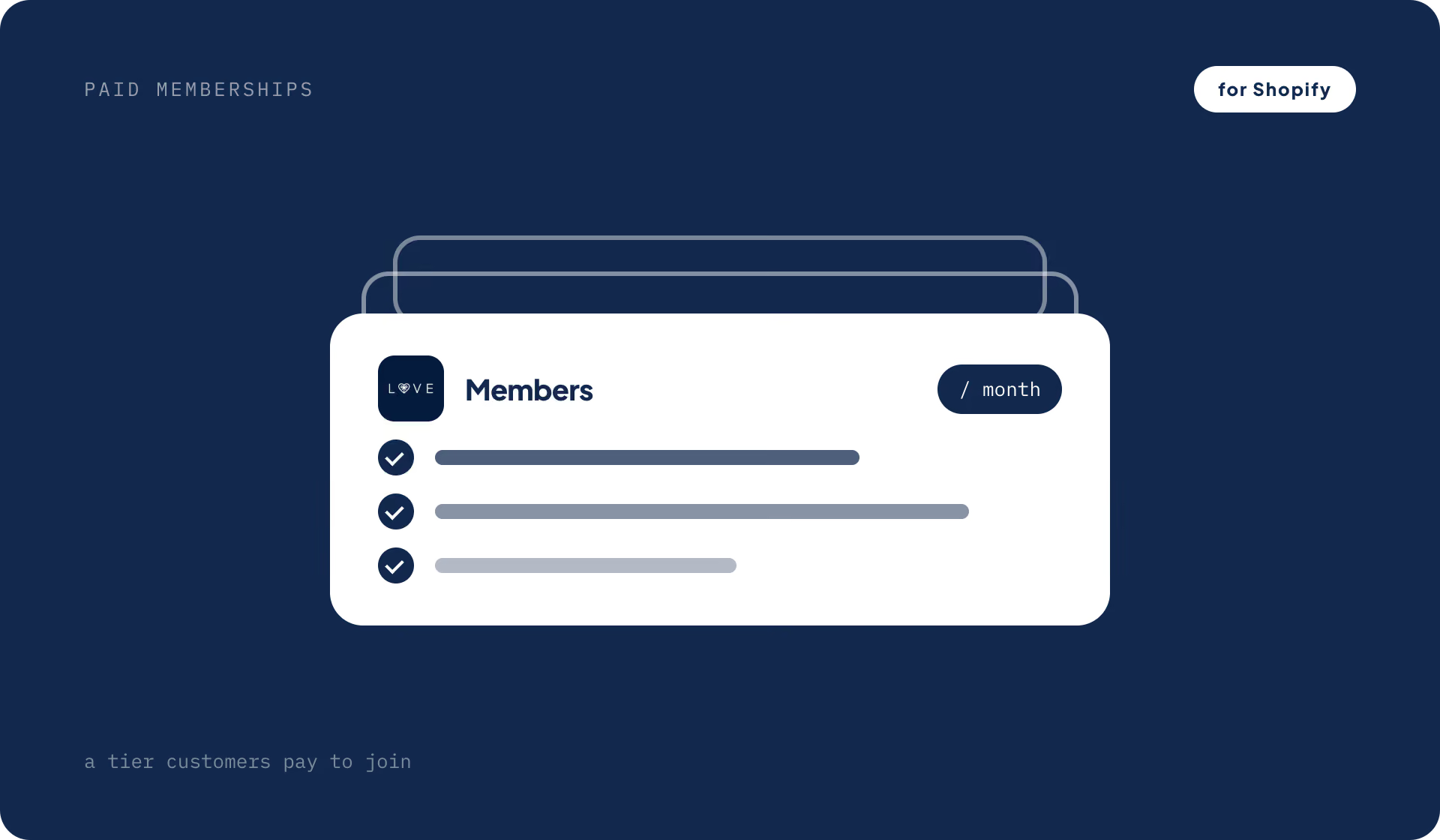
A paid membership is different. The customer pays a recurring fee, or sometimes a one-time fee, in exchange for an upgraded relationship: better shipping, member pricing, early access, the lot. They're paying to be a better customer.
And no, you don't have to choose. The smartest setups run both. A free points programme for everyone, plus an optional paid tier sitting on top for your best customers who want more. If you're still mapping the basics, our loyalty program vs rewards program guide breaks down the free side first.
Paid membership fits brands with three things: high repeat-purchase frequency, healthy margins or a strong average order value, and an identifiable "best customer" segment already spending often.
If your customers buy monthly (supplements, pet food, coffee, skincare refills), a fee they earn back fast is an easy sell. If they buy once a year, you're asking them to pre-pay for value they may never use. That's a churn machine.
Lululemon is a good tell. Free membership. Spend-tiered. Early access and easier returns, no fee, per shop.lululemon.com. Not every brand should charge, and a free tiered programme is sometimes the right call.
So why charge at all? Because when it fits, the lift is real. McKinsey's 2021 paid loyalty research found members of paid programmes are 60% more likely to spend more with a brand after joining, versus 30% for free programmes, and that 63% of consumers already belong to at least one paid loyalty programme. So this isn't some fringe experiment - most people already pay for at least one membership. It's normal now.
You don't have to take the analysts' word for it either. In Love Loyalty's own case studies, bakery brand Rubino now sees about 30% of its revenue come from paid members, who spend roughly 3x what non-members do - members spent around $630,000 in just three months. Félix & Norton tells the same story: its members spend 180% more than non-members, worth about $30,000 in annualised membership sales. That's a Love Loyalty customer turning a paid tier into a meaningful chunk of repeat revenue, not a hypothetical.
Bottom line: if you have frequency, margin and a loyal core, paid can deepen spend rather than scare people off. If you don't, stick with free.
The big paid memberships work because each one nails a single principle. Steal the principle, not the price tag.
Every one of these answers the same question the customer is actually asking: do I get back more than I pay? If yes, they join.
Here's the test for every perk: it has to feel worth more to the member than the fee, and at least one perk should be usable the moment they join. Nobody wants to pay today and wait three weeks to feel the benefit.
The perks that actually convert:
One thing that pays for itself here: hook the membership into your email. Love Loyalty syncs to Klaviyo, sharing profile properties like Love Paid Membership and Love VIP Tier, and firing real triggers such as Paid Membership Started, 7-Day Membership Expiry Reminder and Approaching Next VIP Tier. A win-back or "you're close to the next tier" email is then built in Klaviyo off that synced segment, so renewal nudges run automatically instead of by hand.
One warning on perk design. Opaque or stagnant memberships lose trust fast. Adore Me ran a paid membership for years, but Victoria's Secret, which acquired the brand in 2022, later retired that membership in favour of a standard loyalty programme. The lesson holds either way: a paid programme has to keep delivering perceived value, or members walk. Build a clear skip or pause option and make cancellation easy. Friction-as-retention always backfires.
You've got three pricing models. Recurring (monthly or yearly), one-time (REI style), or credit-based (Fabletics style). Yearly recurring is the most common starting point because it locks in commitment without the high friction of a big lifetime fee.
Whatever you pick, tie the fee to a payback the customer can see. Borrow Thrive's framing: tell them exactly how much they need to spend before the membership pays for itself.
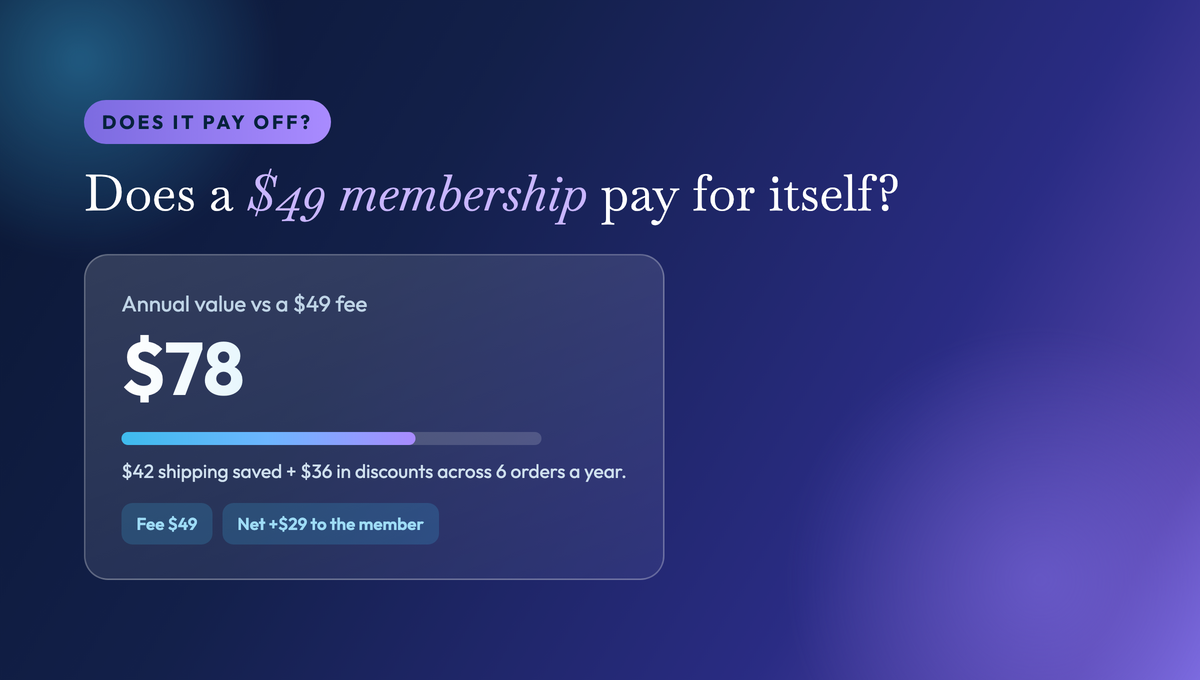
A worked example. Say you charge $49/year for free shipping plus a standing 10% off. If your average order is $60 and shipping costs the customer $7, a member who orders six times a year saves $42 in shipping plus $36 in discounts, which is $78 of value against a $49 fee. That's a clear win for them, and you've locked in six orders.
Now model your side before you commit. That same member cost you the shipping subsidy plus the margin you gave away on the discount. If your gross margin is healthy and the membership drives one or two extra orders you wouldn't have got otherwise, you're ahead. If it just discounts orders that were coming anyway, you're not. Run that maths first.
Antavo's 2025 Global Customer Loyalty Report puts the average loyalty-program ROI at 5.2x. That comes from more orders, bigger baskets and less churn, so the fee is often the smaller part of the win. It's why McKinsey notes paying members can be worth several times more than non-paying members even before you count the fee revenue. Get the perk-to-fee maths right and a well-priced membership compounds into a meaningful slice of repeat revenue over time.
You need two jobs covered: billing the fee, and applying the perks automatically. Get either wrong and you'll be doing manual refunds at midnight.
For billing, Recharge is a common Shopify choice if you want the membership fee billed alongside product subscriptions, per getrecharge.com. Where Recharge shines is mature subscription billing, so it's a solid option for brands already running a subscription business. That said, it's a separate tool from your loyalty perks, so you're stitching two systems together.
For the perks, you want a loyalty app that handles paid memberships natively rather than a separate widget bolted on top. This is where Love Loyalty fits. It's built exclusively for Shopify and stores membership state in Shopify metafields, so it loads fast with no external API lag. Memberships can be sold yearly or monthly with auto-renewal, and perks surface through native embedded app blocks in the theme editor, not pop-ups: in-cart redemption on every plan, and checkout customizations on Shopify Plus. You can also sell memberships in-store via full POS. It's Built for Shopify certified and 5.0-star rated, so this isn't an untested bolt-on.
Switching from another loyalty app? Love Loyalty does a done-for-you migration and imports your loyalty data from any loyalty app within 24 hours, including point balances and points for past actions, so the move off your current tool isn't the thing that stalls the launch.
Here's the honest limitation. Love Loyalty is Shopify-only, so if you're on WooCommerce or BigCommerce, this isn't your tool. Free plan: up to 150 orders a month, with points, in-cart redemption and referrals. POS support starts on the Professional plan at $12/mo. Paid memberships sit a tier higher: they live on Growth ($79/mo, annual $59/mo, with a 1.8% transaction fee on memberships) and on Plus ($399/mo, annual $299/mo, with a lower 0.8% fee), alongside VIP tiers. The paid-membership benefit types you can build are % or amount discounts, free shipping, free products, bonus points, store credit cashback, or custom benefits. Paid plans come with a 14-day free trial. If you want fees billed in the same flow as product subscriptions, treat Recharge and Love Loyalty as complementary rather than expecting a deep one-click sync between them.
The upside of doing it natively: with VIP tiers, referrals, POS and paid memberships from $79/month, the same $79/month barely buys a standalone points program on most platforms. Not sure whether to start with VIP tiers or a paid membership? Our VIP tiers on Shopify guide covers that.
Here's the order that actually works:
Don't drown in dashboards. Watch these four:
If take rate is healthy but retention sags, your perks aren't staying valuable. Fix the perks, not the price. For the wider picture, see our customer retention on Shopify guide.
It's a programme where customers pay a recurring or one-time fee in exchange for premium perks like free shipping, member pricing or early access. It sits above a free points programme as an optional upgrade for your best customers.
A free loyalty programme rewards everyone with points at no cost to join. A paid membership charges a fee, often $20 to $60 a year for a DTC brand, for an upgraded relationship. Many brands run both at once.
Price it against a payback the customer can see. A common DTC range is $20 to $60 a year, and the rule of thumb is that perks should be worth clearly more than the fee. The simplest test: tell members exactly how much they need to spend before the membership pays for itself.
Not necessarily. Recharge can bill fees alongside product subscriptions, but Love Loyalty sells and auto-renews memberships natively with no separate subscription app, applying perks automatically in the cart (at checkout on Shopify Plus).
Paid memberships are on the Growth plan ($79/mo, annual $59/mo, 1.8% transaction fee) and the Plus plan ($399/mo, annual $299/mo, with a lower 0.8% fee). The entry Professional plan at $12/mo does not include paid memberships, though it does include POS. There is a Free plan (up to 150 orders a month), and paid plans start at $12/mo with a 14-day free trial.
Yes. The Free plan covers up to 150 orders a month and includes the points program, in-cart reward redemption, referrals and full customisation with live chat support. It does not include POS, VIP tiers or paid memberships. Paid plans start at $12/mo and come with a 14-day free trial.
Yes, when it fits. Paid members are far likelier to lift spend after joining (see the McKinsey figures above), and Amazon Prime members spend roughly 2x what non-members do, per CIRP (2022).
Track four: take rate (percentage who join), retention or renewal rate, member LTV versus non-member LTV, and payback on perks. If take rate is healthy but retention drops, your perks need refreshing, not your price.
If you're ready to see what a Shopify-native paid membership can do for your store, Love Loyalty is the place to start. Book a free demo today.