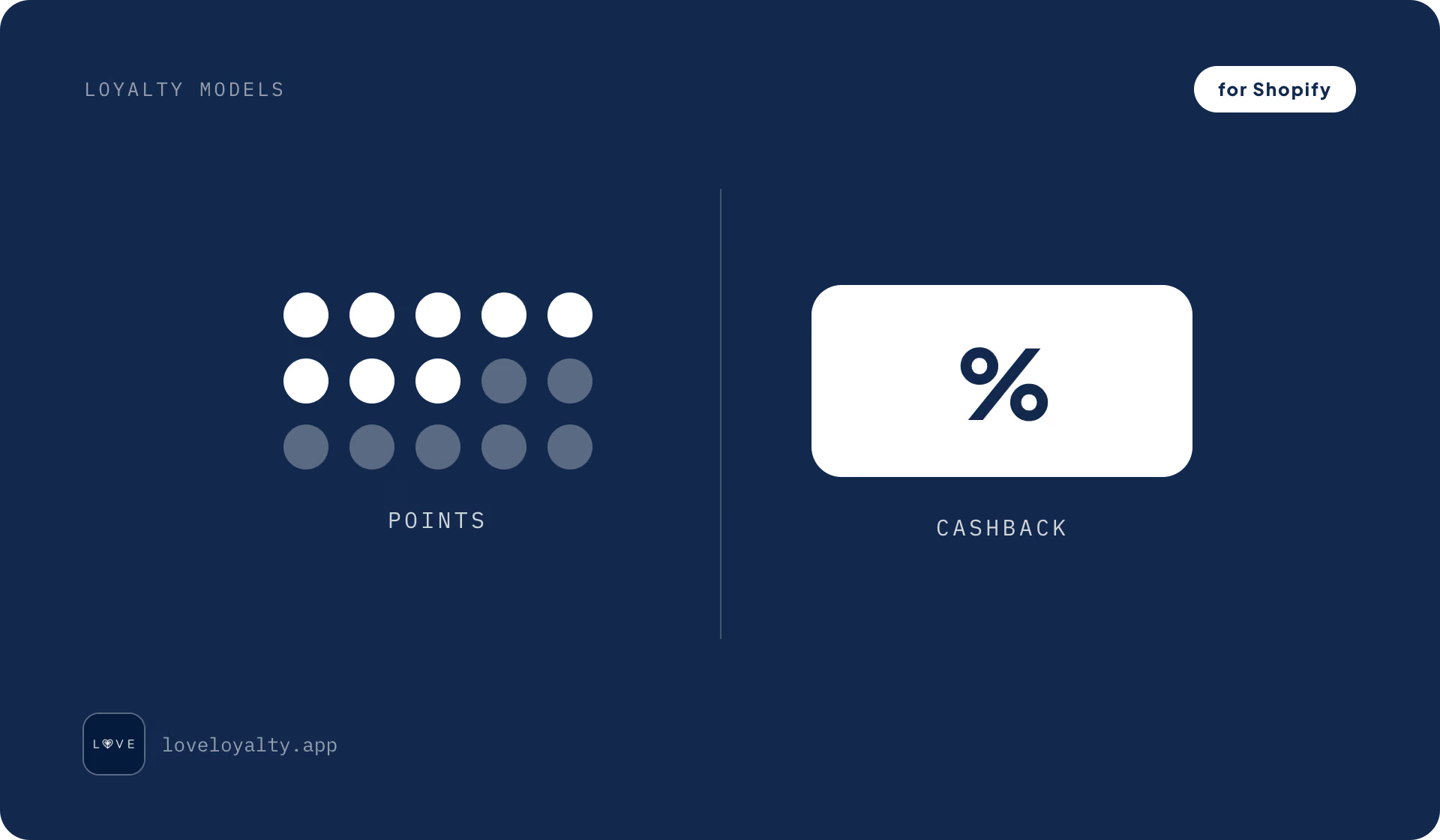
If you've ever watched a discount-trained customer only buy when there's a sale on, you already feel this one. The short version: points win for most Shopify brands because they give people a reason to come back, while cashback quietly trains them to wait for a discount. Below: the psychology, the margin maths, and the brands proving it.
Most people argue points vs cashback like a feature comparison. It isn't. It's a question about behaviour. Points reward you for returning. Cashback rewards you for buying at a discount. Two very different habits, and one of them eats your margin while teaching people to shop on price.
So before you pick a model, ask what you want your customers to do.
Let's keep this plain. A points programme gives shoppers a branded currency they earn per dollar spent, plus bonus actions like signing up, following on social, or a birthday reward. They redeem those points for an amount off, a percentage discount, or free shipping. Some big retailers also let points go toward perks or experiences (REI, The North Face), but that's a brand choice. The key detail: points are brand-locked. They only spend with you.
Cashback returns a percentage of what someone spends, usually as store credit or an annual dividend. REI's co-op model is the cleanest real example. You pay a one-off $30, and you get back roughly 10% of your eligible annual spend as a dividend each year. As of 2024, REI reports 23 million+ members, so it clearly works for them.
The structure is the whole game here. Cashback is brand-neutral. It behaves like cash, so it trains people to value the saving, not you. Points are brand-locked, which makes them a switching cost. This is the lens Cardlytics uses too: cash is brand-neutral, points lock people in. Cash walks the moment a competitor undercuts you. Points can't.
Here's where it actually gets decided. Points feel like a game. People collect them, watch a balance grow, and chase the next tier. That's goal-gradient behaviour, the same pull that makes you finish a coffee loyalty card faster near the end. A points balance is a reason to return that has nothing to do with a sale.
Cashback feels like a delayed discount. And a discount, however you dress it, teaches price sensitivity. Do that long enough and you've built a base that only buys on a deal.
And the research backs it up, not just the gut feel. Wallström et al. (2024) found that programmes built around purely monetary rewards (points framed as cash, discounts, cashback) train customers to behave transactionally, and the people who engage most with those mechanics are often the least attached to the brand. Melnyk and Bijmolt (2015) went further. Monetary savings had no significant effect on loyalty, while recognition, member-only access and events built and sustained it.
The strongest evidence is a 2022 meta-analysis: Liu-Thompkins et al. found emotional drivers of retailer loyalty are 50% stronger than cognitive ones. Bond Brand Loyalty's 2025 report says that for the first time in a decade, exclusive experiences and products have overtaken financial rewards as the top driver.
So: money-only programs pull in your least loyal buyers. Points plus status pull in the ones who actually stick around.
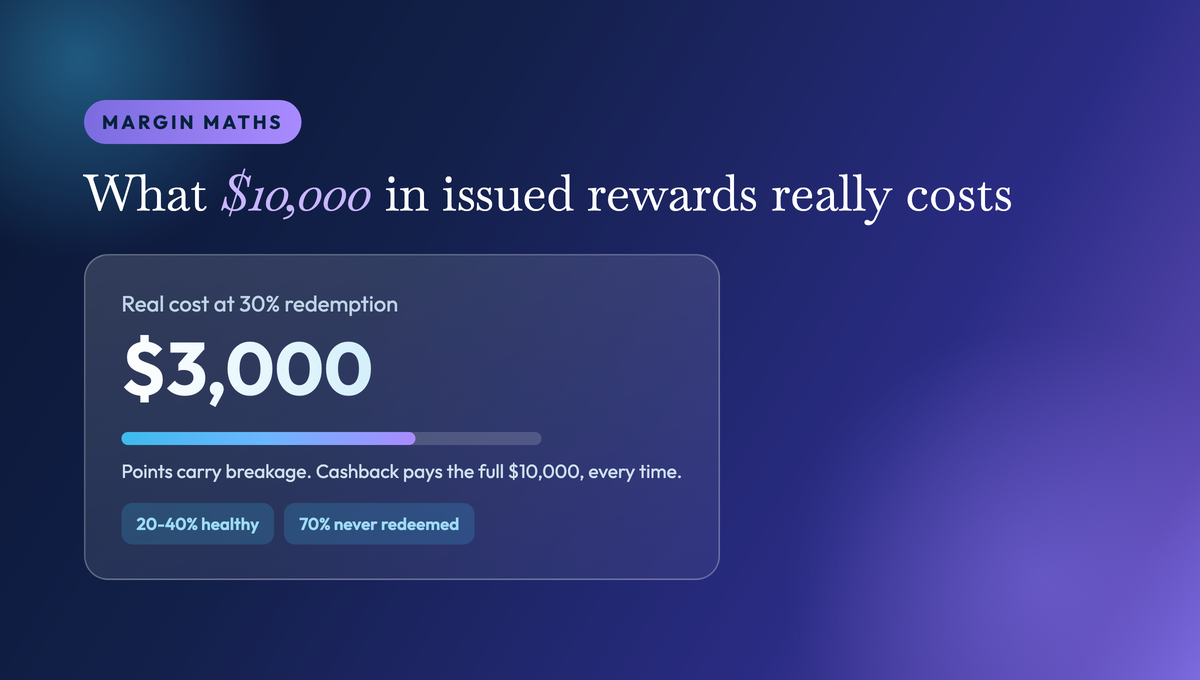
Points don't just win on the brand deck. They win on the spreadsheet too, and here's the line that does it. Points carry breakage. Not every point gets redeemed, so you book a perceived reward value higher than your real cost. Healthy ecommerce redemption sits between 20% and 40%, per Voucherify's 2023 breakage data. Issue $10,000 in reward value at 30% redemption and your real cost is $3,000. Flat cashback has no breakage. You pay every cent, every time.
That gap is the core margin lever. A well-run points programme delivers more perceived value per dollar than cashback, because some of that value is never claimed. Love Loyalty's own customers show what healthy engagement looks like. Agradi, one of Love Loyalty's own case studies, sees a 47% point redemption rate. Yoggies runs hot at 82% redemption with 97.3% of customers taking part - high engagement and very low breakage, which is great for the relationship even if it leaves less margin cushion. That's active spend-and-earn behaviour, not hoarded liability.
Now the honest flip side. Too much breakage signals a broken programme. If redemption falls well below that 20% floor, your rewards aren't compelling or are too hard to claim. Antavo's 2025 report found more than a quarter of US loyalty points go unspent, an estimated $10 billion a year. That's not breakage working in your favour. That's people who checked out.
Outstanding points are also a deferred liability on your balance sheet. McKinsey's 2021 research estimates unused rewards make up to 60% of loyalty liabilities, sitting there with zero engagement. So you want points earned and spent, not hoarded.
For context on whether any of this pays off: Antavo's 2025 report also found 83% of programme owners reported positive ROI at an average 5.2x. Loyalty works. The model you pick decides how well.
Not every brand should run the same thing. Match the model to your category.
Points plus tiers are the right call if you sell repeat-purchase consumables, or you're in beauty, supplements, apparel or pet. These are the verticals where a customer should be back in 30 to 60 days, so a reason to return compounds fast:
Cashback or a dividend only really fits a specific shape: a high-trust, members-own-it identity, or broad, frequent spend across a huge catalogue. REI fits because the co-op identity is the brand. For a typical DTC store doing $200K to a few million, cashback as your only mechanic is usually the wrong call. It costs full freight and builds the least loyal buyers.
If that lines up with your store, our roundup of the best Shopify loyalty and rewards apps is a good next read, and there's a guide for beauty and cosmetics brands too.
The mature answer isn't points or cashback. It's points as the engine, with status and access on top.
Run points to earn the everyday habit. Add VIP tiers for aspiration. Brandon Blackwood does this on a higher-AOV fashion line: 1 point per $1, four named tiers re-earned each rolling year. Gymshark took it further with an XP model that separates earning from spending: members earn XP per dollar plus XP for logging workouts in the app, and that XP unlocks tiers and early access rather than being spent like cash. That's points as identity, the opposite of cashback. You can replicate exactly this in Love Loyalty: tiers can be earned by total points earned or total amount spent, each with its own benefits and optional expiry.
Then add experiences cash can't buy. The North Face XPLR Pass turns every 100 points into a $10 reward, but also lets points go toward things like a guided trip, plus earning for store check-ins. Cashback can't offer any of that.
For your most committed customers, a paid membership locks in the relationship. One Love Loyalty merchant, Rubino, now sees roughly 30% of its revenue come from paid members, who spend about 3x what non-members do. In Love Loyalty a membership is just a Shopify product priced at the fee, with benefits like discounts, free shipping, free products, bonus points or store credit cashback. That's the full ladder: points build the habit, tiers add status, experiences hit emotion, membership locks in your best buyers.
Strategy gets you half way. Most programs then leak the rest in execution. A few rules that move numbers:
And this is the part where the app you pick actually shows up in the numbers. Love Loyalty is built exclusively for Shopify and stores everything in Shopify metafields, so it loads fast with no external API lag. It ships 18 native storefront blocks (cart drawer and page, a dedicated loyalty page, account pages, the product page, the thank-you page), with in-cart redemption on every plan and no pop-up widgets, which is what keeps redemption healthy. Checkout can show the balance too; redeeming at checkout is Shopify Plus only. It also connects to Klaviyo, Shopify Email and Shopify Flow, so you can fire a "close to a reward" email off the synced points balance.
It's also all-in-one. There's a Free plan for up to 150 orders a month covering points, in-cart redemption and referrals. Points, in-cart redemption and POS support for in-store purchases come in from the Professional plan at $12/month (14-day free trial), while VIP tiers and paid memberships start at $79/month on Growth (membership transaction fee 1.8%, dropping to 0.8% on Plus). It's rated 5.0 stars across 200+ reviews and is Built for Shopify certified, so you're not betting on an unproven app. And if you're moving off a legacy app, Love Loyalty does the migration for you and imports your data from any loyalty app within 24 hours, point balances included.
One honest limitation: Love Loyalty is Shopify-only. If you're on WooCommerce, this isn't your tool. If you're on Shopify though, that focus is the reason it loads fast and stays native.
Answer these four and you'll know which way to go.
The one-line default: for most $200K+ Shopify DTC brands, run points as the engine, add tiers and an optional membership, treat cashback as the exception.
Still comparing options? Our pricing breakdown and the Yotpo vs LoyaltyLion comparison go deeper.
Ready to see Love Loyalty in action with your store? Book a free demo today.
For most Shopify DTC brands doing $200K+ a year, points win because they give customers a reason to return rather than a reason to wait for a discount. Cashback only really fits high-trust, members-own-it brands like REI, which as of 2024 reports 23 million+ members on a roughly 10% dividend.
It can, because cashback pays out in full every time with no breakage. Points typically see redemption in the 20% to 40% range, so a slice of what you issue is never claimed and your real cost lands well below face value.
Breakage is the share of rewards that never get redeemed. A healthy 20% to 40% redemption rate lowers your real cost, but if redemption falls well below that 20% floor it signals your rewards aren't compelling. Antavo's 2025 report found over a quarter of US points go unspent, worth about $10 billion a year.
Yes, and you should. As of 2024, Sephora layers 1 point per $1 with VIB ($350 spend) and Rouge ($1,000 spend) tiers, and its loyalty members drive roughly 80% of annual sales. In Love Loyalty, tiers can be earned by points or spend, each with its own benefits.
With Love Loyalty there's a Free plan for up to 150 orders a month that covers points, in-cart redemption and referrals. The Professional plan is $12/month ($10/month annual) and adds POS support for in-store purchases plus a dedicated loyalty page, and it connects to Klaviyo, Shopify Email and Shopify Flow. The Growth plan is $79/month ($59/month annual) and adds VIP tiers and paid memberships. Paid plans come with a 14-day free trial.
The data says yes. Antavo's 2025 report found 83% of programme owners reported positive ROI at an average return of 5.2x, and owners now allocate 31.4% of marketing budget to loyalty and CRM.
Rarely. Cashback alone is brand-neutral and trains price sensitivity, so it suits broad catalogues or co-op identities, not a typical DTC store where points plus status build durable repeat behaviour.