
Most "best loyalty app for shopify" lists treat a $5M brand and a $500M brand like they have the same problem. They don't.
Shopify Plus merchants face higher stakes (bigger AOVs, larger customer lists, more retail and B2B exposure) and a complex tech stack: POS, checkout extensions, Shopify Flow, headless storefronts.
Pick the wrong app and the consequences compound. You overpay 5-10x at Plus volumes. You lose customers to clunky popups that slow checkout. Or you hit a feature ceiling that forces a painful migration two years in, which is the worst of the three
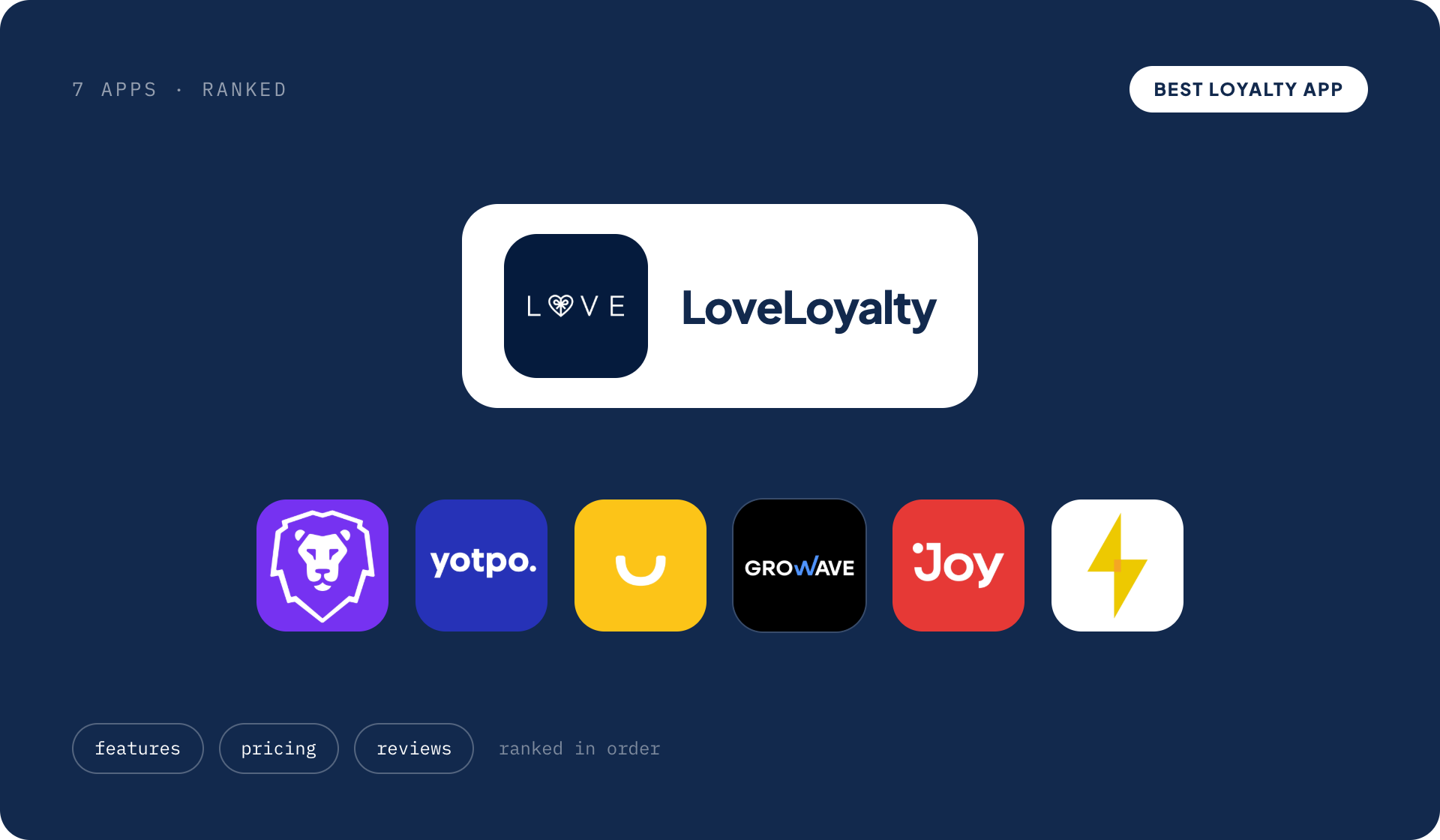
Here are the 7 best loyalty apps for Shopify Plus brands in 2026. Before we get into the list, let's look at the seven factors Shopify Plus merchants should evaluate before choosing a loyalty app.
These are the seven criteria Shopify Plus merchants should evaluate before choosing a loyalty platform.
Apps built exclusively for Shopify integrate natively with Shopify's stack. Multi-platform apps trade depth for breadth, working everywhere because they're not deeply integrated anywhere.
Ask the vendor where loyalty data is stored. Built-for-Shopify apps (like Love Loyalty) store it inside Shopify metafields, so points balances load without external API calls. Multi-platform apps store it in their own database and call it via API, which means every page load with a loyalty widget is another network request.
If you can't open the app and answer "is this paying for itself?" In under two minutes, the app is failing at its job.
Three metrics tell the truth: loyalty-attributed revenue, redemption rate (under 20% means customers don't see or value the rewards), and cohort performance comparing redeemers vs. non-redeemers on AOV and repeat rate. All three should be visible inside the app without exporting CSVs.
For a Plus brand with six-figure customer counts, batch-and-blast loyalty is malpractice.
The baseline is segmentation by recency, frequency, and spend, plus the ability to show different rewards to different segments and sync those segments to Klaviyo for cross-channel personalization. The smartest loyalty apps integrate deeply with Klaviyo instead of trying to replicate it.
Love Loyalty's 20+ native widgets across cart, checkout, product pages, and customer accounts make on-site personalization possible at every step, not just in email.
Loyalty programs go stale fast. Without campaign tooling and custom logic, the program becomes wallpaper within six months.
You need the ability to run double-points weekends, define custom earn rules (3x on full-price, 1x on sale), build tier-specific reward menus, and launch time-bound bonus events without filing a ticket. If the app's "campaigns" feature is a single global multiplier with a start and end date, it's not built for a Plus brand running 20+ promotional moments a year.
A loyalty program that only rewards purchases is a discount program with extra steps.
Real loyalty apps reward reviews, social follows, quiz completions, profile fills, birthdays, and referrals natively. If the app requires a Zapier workaround to reward someone for completing a quiz, it's doing too little. Plus brands almost always have a quiz, a review request flow, or an Instagram follow ask that needs to plug into loyalty without a developer in the middle.
Lifecycle marketing belongs in Klaviyo, not in your loyalty app.
I've seen vendors pitch in-app lifecycle stages with rewards tied to New/Active/At-Risk/Churned. It demos beautifully and breaks in production, because you end up with lifecycle stages defined in two systems that disagree with each other. A better setup pushes loyalty events (points earned, rewards redeemed, tier changes) into Klaviyo as properties and events, and Klaviyo owns the lifecycle logic.
Plus brands process thousands of orders monthly. The right app gives you predictable pricing at your volume, not a pricing page that punishes growth.
Watch for Plus-tier pricing and per-order overages of $15–$20 per additional 100 orders, and core features (paid memberships, POS, API access) locked behind the top tier. An app that costs $199/mo entry but locks the features you actually came for behind the $999/mo tier isn't a $199/mo app.
I evaluated each app against the seven criteria above using public pricing pages, vendor documentation, merchant case studies, and Shopify App Store listings. Apps are ranked by best fit for Shopify Plus brands.
Pricing comparison (entry / mid / top tier, as of 2026):
Built exclusively for Shopify. Love Loyalty is the strongest fit for Shopify Plus brands that have committed to the Shopify ecosystem. It offers points, custom reward rules, VIP tiers, paid memberships, 20+ native loyalty widgets, in-cart redemption, referrals, B2B loyalty, and POS in a single app at one transparent price.
Where it scores against the seven criteria:
1. Built for Shopify, with the badge. Customer points, tier status, and membership data all live in Shopify metafields, which means loyalty widgets load instantly without external API calls.
2. Analytics depth. CLV, loyalty-attributed revenue, and cohort performance (redeemers vs non-redeemers) are tracked natively, with predictive analytics handled in Klaviyo or your CDP.
3. Segmentation & personalization. Behavior-based segmentation by recency, frequency, and spend is native, and you can serve dynamic offers per user across product page, cart, and account widgets. Email and SMS personalization runs through a deep native Klaviyo integration plus 20+ other ESPs, while churn-risk modeling and adaptive personalization stay in the Klaviyo layer where they belong.
4. Customization & experimentation. Custom reward logic beyond preset templates, plus time-bound and rule-based campaigns like double-points weekends. A/B testing runs outside the app.
5. Behavior-based rewards. Full coverage, including rewards for reviews, social engagement (follows and shares), and custom on-site actions like product views, add-to-cart, and quiz completion.
6. Lifecycle marketing. Lifecycle stages (New / Active / At-Risk / Churned), stage-specific triggers, automated winback, and dynamic stage movement all run through the deep native Klaviyo integration.
7. Pricing that stays predictable at Plus volumes. $79/mo for 2,000 orders, $399/mo for unlimited orders. No tiered overages once you're on the top plan.
Above plus checkout extensions, paid memberships (0.8% fee), B2B loyalty, unlimited orders, custom reward actions
By comparison, every other loyalty app either gates two or three of those features behind a custom enterprise plan.
Reviews & Rating: Built for Shopify badge. 5.0 stars on the Shopify App Store across 333 reviews.
Where it falls short. Love Loyalty is built only for Shopify, so multi-platform brands running BigCommerce or WooCommerce alongside Shopify should look elsewhere.
Best for: Shopify Plus brands that want pricing transparency, deep Klaviyo integration, paid memberships, omnichannel POS programs, or a clean migration from a legacy loyalty platform.
LoyaltyLion has been around long enough that a lot of Shopify Plus brands are still on multi-year contracts with it. The issue is that the most valuable features for Plus brands i.e. paid memberships, aren't offered natively at any price point, while other features like VIP tiers are locked behind exorbitant pricing and enterprise quotes compared to competitors.
Where it scores against the seven criteria:
Where it has an edge: if you've built your storefront headless stack, LoyaltyLion's API surface goes further than anything else on this list.
Best for: Plus brands on multi-year contracts who aren't ready to migrate this quarter, and enterprise brands running headless storefronts that need a deep API integration.
Where it falls short for Plus brands. Paid memberships aren't offered natively at any price point, which is a hard cap for any merchant whose retention strategy depends on subscription clubs or bundled membership perks.
Yotpo Loyalty is the loyalty product inside the broader Yotpo suite. It makes the most sense when bundled with Yotpo Reviews and SMS, where cross-product data unlocks reward-for-review loops and connected post-purchase journeys.
The issue for Plus brands is that the most valuable features are gated behind premium pricing and enterprise quotes, and Yotpo prices each product separately, so the bundled-suite argument gets expensive fast.
Where it scores against the seven criteria:
Where it has an edge: if you're already running Yotpo Reviews on Shopify, the shared customer dashboard across reviews and loyalty is a workflow win.
Best for: Plus brands already invested in the Yotpo ecosystem who want a connected reviews + loyalty data layer and have a time and budget to navigate enterprise quote.
Where it falls short for Plus brands. VIP tiers are gated to a custom enterprise quote, and paid memberships aren't natively available at any tier. To get memberships at all, you need a CSM-led implementation on the enterprise plan, which is a steep ask for any Plus brand whose business case for loyalty rests on a paid membership or subscription bundle.
Smile is the most beginner-friendly loyalty app on this list. It offers points, referrals, and VIP tiers in a setup that's the simplest on this list. The issue for Plus brands is what you pay to access the features you actually need, and what's still missing once you do.
Where it scores against the seven criteria:
Where it has an edge: setup is the simplest on this list. A founder with no loyalty experience can install Smile, configure earn rates, and have a working points program live in under an hour.
Best for: brands that prioritize simplicity, run their lifecycle in Klaviyo, and don't need paid memberships, POS, or B2B loyalty.
Where it falls short for Plus brands. Paid memberships aren't supported at any tier, which rules Smile out for any Plus brand whose retention strategy depends on a paid membership program. No native POS, no native B2B. And the order ceiling on the $999/mo Plus tier means high-frequency, lower-AOV categories (consumables, refills, subscription-adjacent products) burn through their order allotment faster than the pricing page suggests. For comparison, Love Loyalty's $399/mo plan covers unlimited orders and includes paid memberships and Shopify POS, at less than half the price.
Growave is an all-in-one app that bundles loyalty with reviews, wishlists, referrals, and UGC tools into a single subscription. It carries the Built for Shopify Plus badge and supports POS, checkout extensions, and multi-language for cross-border selling.
The issue for Plus brands is what's missing from the loyalty layer itself, and how the per-feature cost stacks up against a dedicated loyalty app.
Where it scores against the seven criteria:
Where it has an edge: the all-in-one bundle genuinely reduces app sprawl.
Best for: brands consolidating their app stack and willing to trade loyalty depth for breadth.
Where it falls short for Plus brands. Paid memberships aren't available at any tier, which is the same hard cap that disqualifies most apps on this list for membership-led retention strategies. In-cart redemption is also missing across all plans, which hurts conversion at the moment customers are most motivated to redeem points. For comparison, Love Loyalty's $79/mo plan covers 2,000 orders and includes VIP tiers, paid memberships, referrals, Shopify POS, and in-cart redemption, features that cost significantly more on Growave or don't exist at any tier.
Loyoly is a loyalty platform built around UGC and social engagement as the core earning mechanic. It offers points for purchases plus the widest catalog of non-purchase earning actions on this list, along with VIP tiers and referrals.
The issue for Plus brands is the pricing jump between tiers and what's still missing once you've paid.
Where it scores against the seven criteria:
Where it has an edge: the UGC earning catalog is genuinely valuable.
Best for: brands where customer content is an acquisition channel, and where the team already invests in influencer or UGC programs that loyalty can plug into directly.
Where it falls short for Plus brands. POS isn't available at any tier, which rules Loyoly out for any Plus brand with retail exposure. Paid memberships aren't offered at any price point, and in-cart redemption is missing across the board. For comparison, Love Loyalty's $79/mo plan at 2,000 orders includes VIP tiers, paid memberships, Shopify POS, and in-cart redemption for features that either cost an order of magnitude more on Loyoly.
Nector is a loyalty-plus-reviews bundle app positioned as a budget pick. It offers points, reviews, and birthday and anniversary rewards in a single subscription. The issue for Plus brands is that the features that actually matter at scale are scattered across three tiers and a custom quote.
Where it scores against the seven criteria:
Where it has an edge: custom rewards like built-in birthday and anniversary rewards are a quiet win.
Best for: smaller brands at the early-validation stage who want a points-plus-reviews bundle in a single subscription and don't yet need VIP tiers, paid memberships, or POS.
Where it falls short for Plus brands. The features that matter most at Plus scale are scattered across tiers and a custom quote. VIP tiers don't appear until the $349/mo Premium plan, and paid memberships and Shopify POS sit behind a custom Enterprise quote with no published price. That's a hard ceiling for any Plus brand whose growth plan includes a paid membership program or retail exposure. For comparison, Love Loyalty's $79/mo mid-tier bundles VIP tiers, paid memberships, Shopify POS, and in-cart redemption into one published plan, which makes Nector's "budget pick" framing harder to defend once you map total feature cost.
Four questions resolve most loyalty app decisions for Shopify Plus brands.
Love Loyalty offers flat unlimited orders at $399/mo. LoyaltyLion can hit $1,650+ once you stack tiers and add-ons. Smile's $999/mo Plus plan caps at 7,500 orders, so high-frequency categories burn through allotments fast. If your finance team needs a loyalty line item that doesn't move every quarter, the gap between transparent flat pricing and custom enterprise quotes is the first thing to weigh.
Love Loyalty offers native paid memberships with a 1-click checkout upsell that applies benefits to the same order instantly. Most apps on this list don't offer paid memberships natively at any tier, which means you'll migrate later to add them. This is the single most common reason Plus brands switch loyalty apps 12 months after their initial pick. If memberships are on your roadmap at all (even speculatively), choosing an app that can't run them is choosing a future migration.
Apps built exclusively for Shopify store loyalty data in Shopify metafields, which loads without external API calls. Multi-platform apps store data in their own database and call it via API, so every loyalty widget on a product page, cart, or account page adds a network request. At Plus traffic volumes that overhead is measurable, and it compounds with every widget you add.
This matters more than it sounds. Love Loyalty's 20+ native widgets across cart, checkout, product pages, collection pages, customer accounts, and the thank-you page mean customers see their points balance, member pricing, and reward progress at every step of the journey. Visibility drives enrollment. Enrollment drives redemption. Redemption drives repeat purchase. Apps that rely on a single account-page widget plus popups break that chain at the first link.
If you already run Klaviyo deeply, the right loyalty app integrates rather than duplicates. Apps that try to own lifecycle in-app (LoyaltyLion, Nector) create two-system fragmentation where "At-Risk" means one thing in the loyalty app and another in Klaviyo. Love Loyalty pushes loyalty events into Klaviyo as properties and events, and lets Klaviyo own the lifecycle logic, which is where it belongs for any Plus brand.