You're paying for a loyalty app every month and you can't tell if it's earning you a dime. Nobody finds the points, nobody redeems them, and the bill renews anyway. That's the real problem with most loyalty programmes, and it's why the best Shopify loyalty app for revenue isn't the one with the longest feature list. It's the one that puts rewards in front of shoppers at the exact moment they're deciding to buy, and lets them redeem in the cart without fighting a pop-up. Get that right and a loyalty programme quietly lifts your repeat rate, your AOV and your lifetime value. Get it wrong and you're paying monthly for points nobody can find.
Most loyalty buyers start by comparing feature checklists. That's backwards. Evaluate a loyalty app the way a CFO would: what does it actually do to revenue, and by how much? So let's run the maths first.
Let's run a quick hypothetical. Say you do roughly 5,000 orders a year at $200K+ in revenue, and your repeat-purchase rate is sitting around 28%, normal for a DTC brand that's never run loyalty properly. Lift that to 33%, just five points, and you've turned a chunk of one-time buyers into second and third orders. On a 5,000-order base, that's real money, and it compounds every quarter.
Why does loyalty move that number at all? Because rewards change behaviour. Bain & Company research (Reichheld, 2014) found that increasing retention by 5% can lift profits by 25% to 95%, depending on the industry. People come back when there's something waiting for them. It's not magic. It's just incentive.
So run your own version of that sum before you pay for anything. Take your order count, your current repeat rate, and ask what a 3 to 5 point lift is worth. That number is your loyalty budget ceiling, and it's the bar a programme has to beat.
For a sense of the upside, look at what Love Loyalty's own case studies report. Agradi drives 17% of its total sales through the programme, and Biscuiteers has generated $70,000 in loyalty revenue in a single month. That's the kind of number a programme has to be capable of for the maths to work.
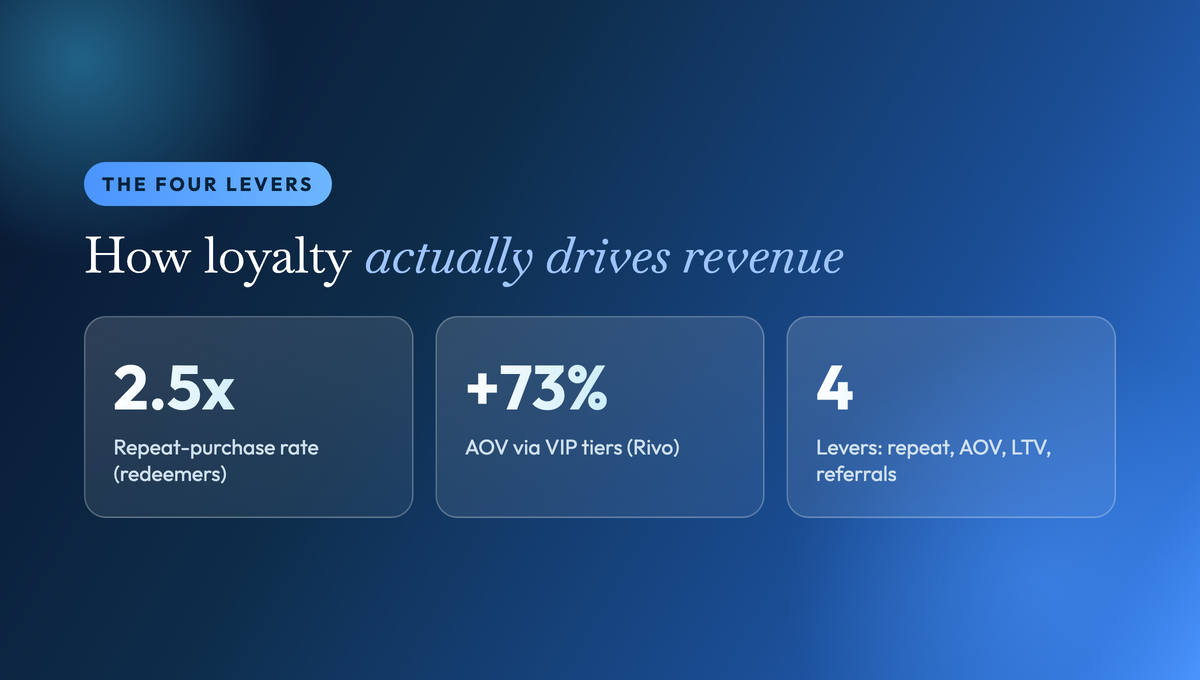
Loyalty doesn't lift revenue by accident. It pulls four levers, and the good apps work all four at once.
This is the headline driver. Customers who redeem rewards come back far more often than customers who never redeem. The word that matters there is redeem. Earning points does nothing. Spending them is what brings people back for order number two.
Tiers are where AOV quietly climbs. When a customer is $20 away from the next tier, a lot of them top up the basket to get there. With Love Loyalty, tiers are earned by total points earned or total amount spent, each tier carries its own benefits, and you can set tiers to expire so the status stays worth chasing. People spend to climb. The tier does the selling for you.
Look at 100% Pure's "Purist Perks", which runs spend-based tiers with early access and priority service at the top. Or Caraway, which pairs tiers with exclusive early access to product drops.
The smartest programmes reward engagement, not just dollars. Gymshark's loyalty programme awards points for shopping plus actions like signing up to email and SMS. OLIPOP gives points for social follows and for joining its email and SMS lists, with rewards that keep people coming back. Every one of those actions gets a customer invested before they buy again. That's how you grow LTV instead of renting it from Meta every month.
Acquiring a new customer is commonly cited as 5x to 25x more expensive than retaining one (Harvard Business Review, 2014). Referrals flip that. OLIPOP runs a "Give $15, Get $15" referral offer. Blume's "Blumetopia" hands out "Blume Bucks" for purchases, social follows and referrals. Every referred customer is one you didn't have to buy on Meta. That's margin you keep.
So why do two loyalty apps with identical feature lists produce wildly different revenue? It comes down to one thing: visibility and redemption UX. This is the part most buying guides skip.
Points a shopper never sees can't change behaviour. Antavo's 2025 Global Customer Loyalty Report estimates that more than a quarter of loyalty points go unspent, roughly $10B in unredeemed value a year. That's not customers being lazy. That's programmes hiding the reward behind a single pop-up widget nobody clicks.
Now stack redemption on top. Cart abandonment already sits above 70% (Baymard Institute, 2024). If a shopper has a reward but can't apply it in the cart, you've added friction at the exact moment you needed to remove it. The reward that was meant to close the sale becomes the reason they bail.
So the real test isn't "does it have referrals?" It's "where do the rewards show up, and can people actually use them there?" Rewards embedded across the storefront beat a clever feature buried in a tab. Every time.
This is where being built inside Shopify, not on top of it, actually pays off. Love Loyalty stores everything in Shopify metafields rather than calling an external API on every page load, so the placements load fast and reliably. A slow or broken loyalty widget costs you conversions, and you'd never even see it in your analytics.
It also runs 18 native app blocks across the storefront, theme-editor blocks, not pop-ups, so points and rewards show up on the product page, the cart, the dedicated loyalty page, the account pages and the thank-you page, with the balance also visible at checkout. Redemption happens right in the cart on every plan, and redeeming at checkout is a Shopify Plus add-on (checkout customizations are Plus-only). Customers just apply points where they already are. That kills the friction right when someone's about to buy. For more on this, our guide on how to increase your repeat purchase rate goes deeper on the redemption mechanics.
Once you've got visibility right, the next revenue question is whether the levers reinforce each other. They only do that if they live in one app.
When points, VIP tiers, paid memberships, referrals, POS and B2B all run from the same system, tiers feed referrals, referrals feed AOV, and memberships lock in recurring commitment. Bolt three separate apps together and you get tech debt, conflicting data, and features that don't talk to each other. If you're weighing online plus in-store, our guide on running an all-in-one loyalty programme online and in store shows how one system covers both.
People sleep on paid memberships. A paid membership creates a financial reason to keep shopping with you, not the competitor. If you want to see how that model works, we broke it down in paid membership programmes on Shopify.
The proof shows up in the numbers. Antavo's 2025 Global Customer Loyalty Report found that 83% of programme owners report positive ROI, and that tiered programmes tend to outperform non-tiered ones. Tiers, done right, are a revenue engine, not a vanity badge. If you're starting from scratch, our walkthrough on how to build a loyalty programme on Shopify covers the setup step by step.
So where does Love Loyalty land in all this? It's a strong value pick, and here's the honest framing. It's built exclusively for Shopify, holds Built for Shopify status, and carries a 5.0-star rating on the App Store. Here's what you get:
That last point is the one that ties straight back to the visibility argument above. The rewards show up where people are already shopping, and they redeem without leaving the cart. A "you're $20 from a reward" nudge or a win-back email is built in Klaviyo off the synced balance and segment.
On price, weave it into your own maths rather than mine. Here's how the plans break down:
All paid plans come with a 14-day free trial. For a brand replacing legacy tools, getting POS and the core programme from $12/month, then tiers and memberships from $79/month, is genuinely competitive.
Now the honest limitation, stated plainly: the Free plan is capped at 150 orders and does not include POS, VIP tiers or paid memberships. POS support starts on Professional at $12/month, while VIP tiers and paid memberships start on Growth at $79/month. Budget for Growth if tiers and memberships are the point.
And the obvious one: Love Loyalty is Shopify-only. If you're on WooCommerce or BigCommerce, this isn't your tool. No amount of features changes that.
Where competitors like Yotpo shine is deep analytics and a broad marketing suite, and Smile.io is genuinely easy to start with. Yotpo's analytics are deeper than ours, full stop. If reporting depth is your priority, that's a real reason to look at them. That said, if your revenue comes from embedded, in-cart redemption and a native, fast storefront experience, that's the lane Love Loyalty was built for. Still comparing your options? Our roundup of the best Shopify loyalty and rewards apps lays out the field.
Before you commit, run any app through this checklist:
If you want help weighing these, our guide on how to choose a loyalty rewards platform walks through each one in detail.
If your revenue lives in the cart, that's the lane Love Loyalty was built for. Want to see it running on your store? Book a free demo.
The best one for revenue is whichever makes rewards most visible and easiest to redeem in the cart, because redeemers come back far more often than non-redeemers. Love Loyalty is built natively for Shopify with 18 storefront app blocks, in-cart redemption on every plan and a 5.0-star App Store rating.
Through four levers: a higher repeat rate, higher AOV from VIP tiers, higher lifetime value, and referrals that lower your paid acquisition costs. Antavo's 2025 Global Customer Loyalty Report found that 83% of programme owners report positive ROI.
Yes. The Free plan is $0/month for up to 150 orders and includes the points programme, in-cart redemption, referrals and full customisation with live chat. It does not include POS, VIP tiers or paid memberships. Paid plans start at $12/month (Professional), which adds POS support, and every paid plan comes with a 14-day free trial.
Yes. Customers top up baskets to reach the next tier, which lifts average order value. With Love Loyalty, tiers are earned by total points earned or total amount spent, each tier has its own benefits, and tiers can be set to expire so the status stays worth chasing.
Because cart abandonment sits above 70% (Baymard Institute, 2024) and more than a quarter of points go unspent (Antavo's 2025 Global Customer Loyalty Report). Letting customers apply rewards directly in the cart removes friction at the buying moment, which is where revenue is won. In-cart redemption works on every Love Loyalty plan; redeeming at checkout is a Shopify Plus add-on.
Yes, POS support is included from the Professional plan at $12/month, so your loyalty programme works the same online and in person. The Free plan covers up to 150 orders but does not include POS, so you need at least Professional for in-store loyalty.
Yes, it's built for brands replacing legacy tools, with a done-for-you migration and loyalty data import within 24 hours, point balances included. You get points, referrals and in-cart redemption from the Free plan, POS support from Professional at $12/month, and VIP tiers plus paid memberships from Growth at $79/month. It's Shopify-only, so it isn't an option if you're on WooCommerce or BigCommerce.