Rip a loyalty app out of a store 18 months in and six things break at once, in front of customers. The bill balloons at the next order tier. Point balances get reset to zero. That's the moment you realise you weren't picking an app. You were picking storefront infrastructure.
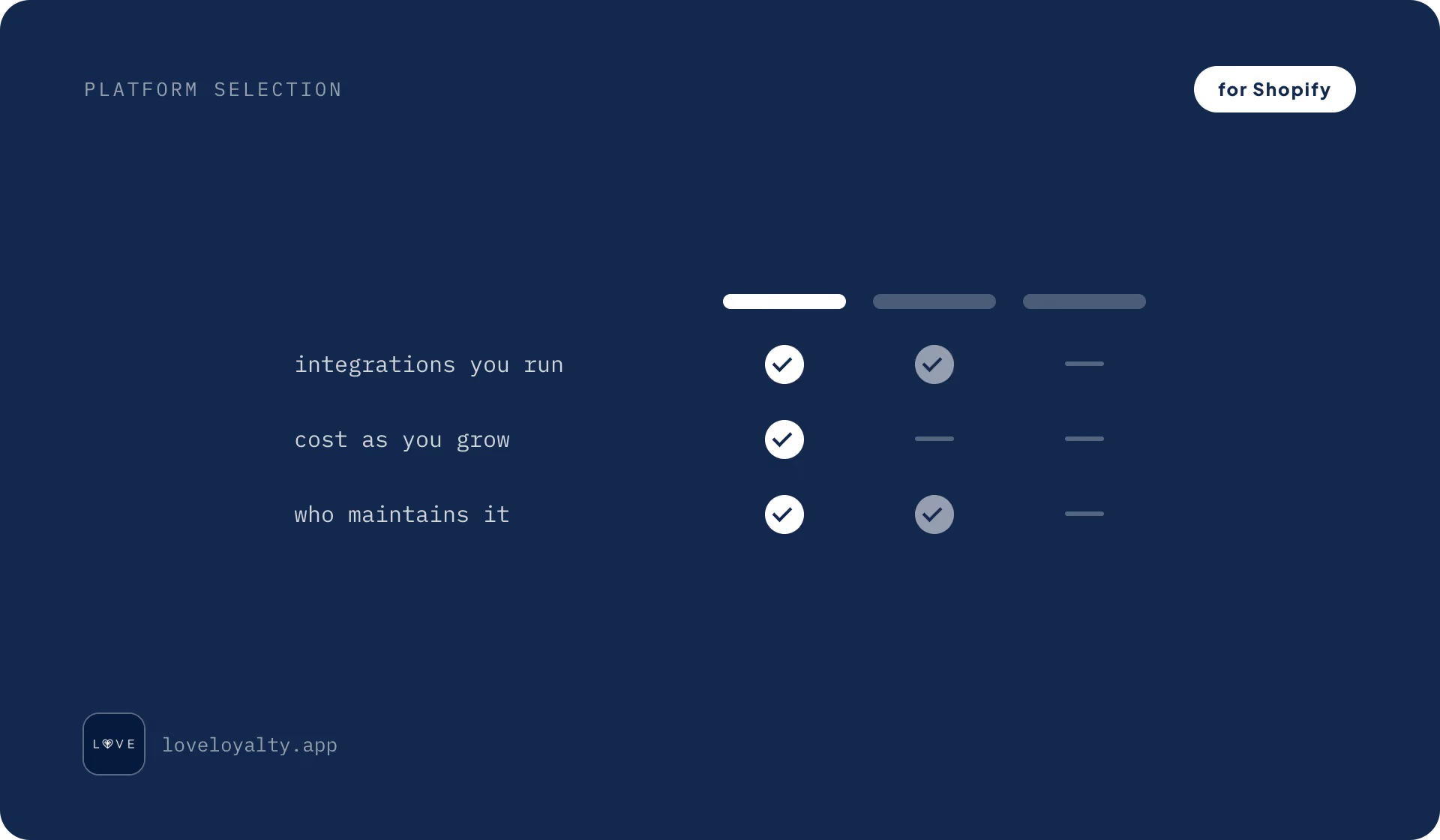
To choose a Shopify loyalty platform, score every shortlist app on nine criteria: native performance, touchpoint coverage, pricing at scale, all-in-one breadth, integrations, POS, migration, support and Built for Shopify status.
Why does that matter? A loyalty programme touches every storefront surface a shopper sees, plus your POS and email stack. So the right question isn't "which one has the most earn rules?" It's "which one will still serve me at 3x my order volume, look native to my store, and never trap my customers' points if I leave?"
Loyalty's worth getting right because it pays. Antavo's 2025 Global Customer Loyalty Report (2,600 marketing leaders, 10,000 shoppers) found programme owners pull 5.2x more revenue than the programme costs, and 83% who measure ROI report a positive return. The upside's real. So is the downside: once a programme's live across your storefront, switching hurts, and your customers see it.
So let's get the criteria right before you start a free trial. This is the checklist we'd run a shortlist through in an afternoon.
Count where a points programme actually shows up. The product page ("earn 120 points"). The cart. The checkout. The account page. The thank-you page. Your POS if you sell in-store. And your Klaviyo flows firing points-balance reminders.
That's six or seven surfaces, all wired to one app. Rip it out 18 months from now and every one breaks at once, in front of customers. So "most features" is the wrong lens. Choose for where you'll be in 18 months, not where you are today.
Nine criteria, ordered by how often they bite in practice.
This is a performance decision, not aesthetics.
Older loyalty apps inject code and bolt a pop-up widget onto your theme. It lags. It looks like it doesn't belong. And it can drag your page speed down, costing you conversions before anyone even earns a point.
Native apps built as theme app extensions, with data stored in Shopify metafields, load faster and conflict less with your theme. There's a measurable test here. Shopify's Built for Shopify certification caps the storefront speed hit at 10 performance points, with LCP under 2.5s and CLS under 0.1. A pop-up-only widget rarely clears that bar, and Shopify verifies the badge itself, so the certification and the speed claim are the same proof point.
Love Loyalty stores everything in Shopify metafields rather than calling an external API on every page load, so there's no widget lag and nothing bolted on. The flip side: that exclusivity means it only works if you're on Shopify. If you are, it's exactly why the experience loads fast and looks native.
Most buyers get this backwards. Placement drives engagement way more than how many earn rules you have.
You can have 30 ways to earn points. If members only ever see their balance buried on a separate page, engagement stays flat. The programmes that move revenue show up where people already are.
The touchpoints that matter:
In-cart redemption is the underrated one, and it works on every plan. Apply a reward right in the cart, no pop-up and no detour, and you remove the friction that kills redemption. Redeeming at checkout is a different thing: it runs on checkout extensions, which Shopify limits to Plus merchants, so don't assume checkout redemption is universal. Love Loyalty runs 18 native storefront app blocks across the cart drawer and page, a dedicated loyalty page (hero, how it works, ways to earn, ways to redeem), customer account, the product page, the thank-you page and checkout. They're embedded theme-editor blocks, not pop-ups. Count placements, not just earn rules.
What does that get you? One of Love Loyalty's own case studies, Agradi, drives 17% of total sales through its programme, $900k in loyalty revenue in 2 months.
Loyalty apps usually price one of two ways. A flat monthly fee with a hard order cap, or usage-based with per-order overages. Some force you up to the next tier at the cap. Others quietly charge overages that can double your bill without warning.
Do this before you commit: model your bill at 2x and 3x your current monthly orders. Watch for per-100-order overages and membership transaction fees.
The numbers compound fast, so here's how three of the bigger names scale, per their public pricing pages, June 2026:
None of that's a dig at them. It's just how fast the bill climbs. Love Loyalty's pricing is public, and there's a genuine Free plan. Here's how the four plans break down:
Every paid plan includes a 14-day free trial. Points, in-cart redemption and referrals are on every plan, including Free. POS arrives at Professional. VIP tiers and paid memberships start on Growth. Checkout extensions, which let customers redeem at checkout rather than in the cart, land on Plus.
Bottom line: the cheapest plan today can be the most expensive at 3x orders. Model your bill at 2x and 3x before you sign.
You can build loyalty out of separate apps. One for points, one for memberships, one for referrals, one for VIP tiers. It works, technically. Then you're paying four bills, juggling four widgets, and reconciling data across systems with no shared ledger.
All-in-one keeps points, VIP tiers, paid memberships, referrals, POS and B2B on one ledger. One balance per customer. No reconciliation headaches when someone earns in-store and redeems online.
Love Loyalty puts all of that under one roof. Paid membership is a Shopify product priced at your membership price, with documented benefit types: % or amount discounts, free shipping, free products, bonus points, store-credit cashback and custom perks. POS support comes in from $12/month on Professional, VIP tiers and paid memberships from $79/month on Growth, and referrals are on every plan down to Free. The same money barely buys a standalone points programme elsewhere. The win isn't just cost. It's that everything reads from one ledger, so data stays clean.
A loyalty programme that doesn't sync to email and SMS is dead weight. Points pile up while your best retention channel can't see them.
The integrations to check: Klaviyo, where you build points-balance and win-back emails off the synced data; Recharge if you run subscriptions; Shopify Flow for automation; and reviews like Judge.me, so you can tie review activity into your loyalty flow. Love Loyalty connects to all of these, plus Shopify Email.
The Klaviyo sync is worth knowing in detail. You connect it under Integrations > Klaviyo, and Love Loyalty pushes 5 profile properties (Love Points Balance, Love VIP Tier, Love Birthday, Love Paid Membership and Love Referral URL) plus 12 events, including 7-Day and 30-Day Point Expiry Reminders and 7-Day and 30-Day Birthday Reminders. So rather than a "you have 500 points expiring" email firing after the points already lapsed, the expiry reminder fires on time, and a win-back email is one you build in Klaviyo off the synced balance and tier. If you're a heavy Klaviyo shop, our deeper take lives in the best Shopify loyalty app for Klaviyo users.
If you sell in-store and online, customers expect one point balance everywhere. Earn in the shop, redeem online, and vice versa.
The brands that nail this make it look easy. OLIPOP gives customers 50 points per $1 spent online or via uploaded in-store receipts, plus points for email and SMS signup. Liquid Death's Country Club programme issues a membership card you can add to Apple or Google Wallet, so the loyalty currency travels with the customer. Terms like these change, so check current versions before you copy them.
If you have a physical presence, POS support isn't optional. On Love Loyalty it's included from the Professional plan at $12/month. The Free plan, capped at 150 orders, leaves POS out, so in-store sellers want at least Professional. More on stitching the two together in all-in-one loyalty across online and in-store on Shopify.
This is the one people learn the hard way.
If you're replacing a legacy platform, can the new one import existing point balances and VIP tiers without resetting customers to zero? Because a reset is a broken promise. A member who logs in to find their 4,000 points gone doesn't read "data migration". They read "this brand stole from me".
The risk is real at scale. Antavo's 2025 Global Customer Loyalty Report found more than 26% of US loyalty points go unspent, an estimated $10 billion in unredeemed value a year. That balance is a liability you must carry over correctly when you switch.
This is where Love Loyalty has a documented answer. Per its help docs, Love Loyalty does a done-for-you migration and loyalty data import from any loyalty app within 24 hours, importing point balances and even awarding points for past actions. The practical move is the safe one: carry balances over unchanged, reconcile against the legacy system before cutover, and tell members clearly. Legacy data is usually messy, with incomplete exports and rules living in spreadsheets, so ask any vendor exactly how they handle import before you sign.
A programme that takes weeks to configure is a hidden cost. So is a support team that ghosts you after onboarding. Merchants on the Shopify App Store flag this constantly: they hit the order cap mid-month and get told to upgrade or eat the overages, with nobody picking up the chat.
Ask two things. How long does setup actually take, and what does support look like once you're live? Love Loyalty pairs fast guided setup with an AI loyalty builder, and the docs back a done-for-you migration from any app within 24 hours. Every week your programme isn't live is a week of repeat revenue you're handing to nobody.
This one you can check yourself in ten seconds. Look for the Built for Shopify badge on the listing, because Shopify verifies it, not the vendor.
Built for Shopify is Shopify's official quality certification. To earn it, an app must keep the storefront speed hit under 10 performance points, hold a minimum recent rating, and keep core functionality inside the Shopify admin. It's not marketing. It's verified by Shopify.
Love Loyalty is Built for Shopify certified and holds 5.0 stars across 200+ reviews on the App Store. Star counts drift, so confirm the live listing on the day you decide. If a tool you're considering doesn't have the badge, ask why. The proof a strong choice scales is in the merchant base too: Love Loyalty's customer Biscuiteers had 9,200+ active members on the programme as of February 2026.
Run, don't walk, if you see:
On free plans: there's no shame in a tool charging for what's valuable. The trap is a free tier that quietly caps the features that drive repeat purchases, then hides the real cost behind a paywall. For the record, Love Loyalty's Free plan is real, capped at 150 orders, and the honest limit is what it leaves out: POS, VIP tiers and memberships. Paid plans start at $12/month and every one includes a 14-day free trial, so you can test the full feature set before you pay. Be honest: does "free" mean free, or "free until it matters"?
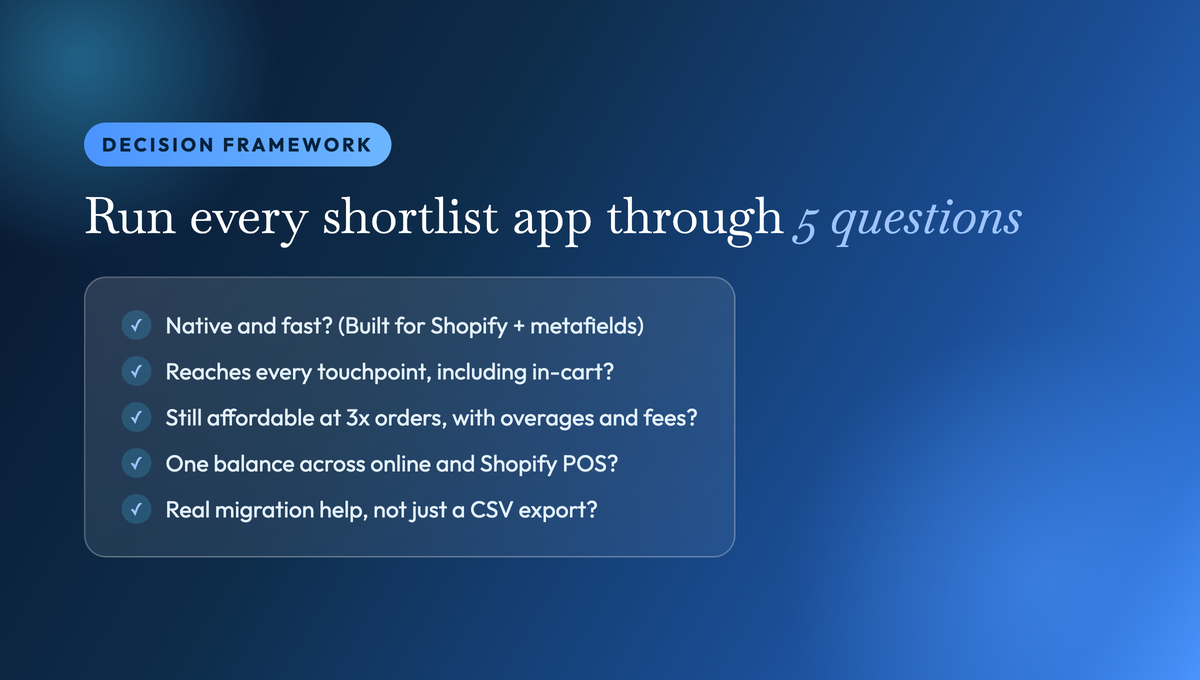
Run every app on your shortlist through these five questions:
If a tool stumbles on questions 1, 3 or 5, cross it off. Those three hurt most after you've committed.
More features is not the same as the right model. The best programmes pick a structure that fits how the brand actually sells.
Glossier skips a classic points programme. It leans on a double-sided referral and First Access perks, fitting its community-led brand. OLIPOP goes the other way with a full points programme and omnichannel earning, because high-frequency beverage purchases reward it. Monos runs Wayfarer Rewards, a points-and-perks model built to scale into recurring value. And paid membership is a high-ceiling model when product cadence supports it. Fabletics' VIP membership is the classic example, turning a membership base into significant recurring annual revenue. Specifics like these change, so confirm current terms before you lean on any single brand as your template.
Different models, all right - because each fits the brand running it. Decide your model first, then choose the platform that runs it best. If you want help mapping that, start with loyalty program models: points, tiers and membership.
Honest caveat before you shortlist anything: Love Loyalty is Shopify-only. If you're on WooCommerce or BigCommerce, this isn't your tool, and that's fine. But if you're on Shopify, building exclusively for the platform is exactly why it loads fast and looks native.
Ready to see Love Loyalty in action with your store? Book a free demo today.
Run your shortlist through five questions: will it look native and stay fast, will it reach every touchpoint including in-cart redemption, what's your bill at 3x orders, does it run everything on one ledger and sync to Klaviyo, and can it import existing points without a reset. Prioritise native, Built for Shopify tools, because the 10-point speed cap protects your conversions.
A native app is built as a theme app extension and stores data in Shopify metafields, so it loads fast and looks on-brand. A pop-up widget injects external code that lags and can drag your page speed below the Built for Shopify cap of 10 performance points.
It varies sharply by order volume. Smile.io rises from around $15/mo at 500 orders to roughly $999/mo at 7,500 orders, while LoyaltyLion's paid tiers commonly start around a $199/mo floor. Always model your bill at 2x and 3x your current orders before committing.
Yes, if the platform supports balance import. Love Loyalty's docs describe a done-for-you migration from any loyalty app within 24 hours that carries over point balances. Best practice is to keep balances and tiers unchanged, reconcile against the old system before cutover, and tell members what's happening. With over 26% of points going unspent, per Antavo's 2025 Global Customer Loyalty Report, that carried-over balance is a real liability you must handle correctly.
Yes. Love Loyalty has a Free plan at $0/month that covers up to 150 orders a month with points, in-cart redemption and referrals, plus full customisation and live chat. It does not include POS, VIP tiers or paid memberships. Paid plans start at $12/month, or $10/month billed annually, on the Professional plan, which adds POS support and covers 500 orders, and every paid plan comes with a 14-day free trial. VIP tiers and paid memberships start at $79/month on the Growth plan.
Only if you sell in-store, but if you do, it's essential so customers keep one point balance online and in-store. Brands like OLIPOP let customers earn via uploaded in-store receipts, and Love Loyalty includes POS support from $12/month on the Professional plan. The Free plan covers up to 150 orders but does not include POS, so in-store sellers should start at Professional.