You launched a points programme, customers shrugged, and now you're not sure which idea is actually worth your time. You're not alone. The short version: the best loyalty programme ideas in 2026 reward what customers do beyond buying, because acquisition keeps getting more expensive and retention is the cheapest growth you've got. The good ones pay you back for reviews, referrals, follows, even birthdays. Not just the sale. Below are 14 ideas, each one running at a real brand right now, with a note on how you'd build it on Shopify. Keep reading.
Customer acquisition has trended more expensive in recent years, so a loyalty programme is now a margin decision, not a nice-to-have.
And there's a proof point worth leading with. Yoggies, a Love Loyalty customer, hits a 97.3% participation rate with an 82% redemption rate, and 66% of its sales come from members (Love Loyalty customer data). That's what a focused programme does when customers can actually see and redeem the reward. So the question isn't whether to run a programme. It's which two or three ideas actually move the needle for your store.
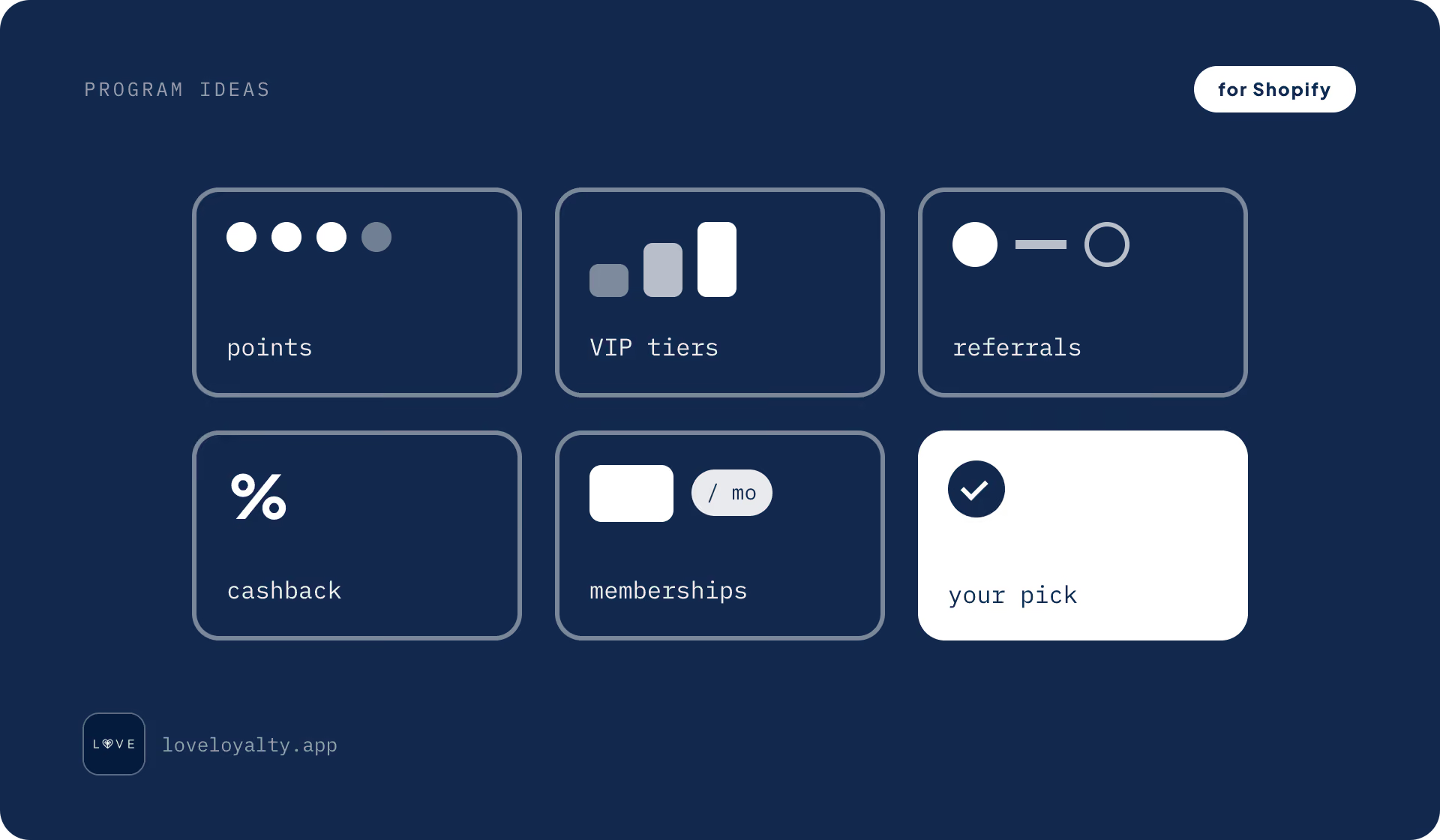
I've grouped 14 ideas into four buckets so you can scan: earning, status and access, word-of-mouth and moments, then emotion and belonging. Steal the two or three that fit. Don't ship all 14.
This is the entry point, and it works because it's simple. Spend money, earn points, redeem for a discount. Olipop, the prebiotic soda brand, runs points-for-purchase that plug into Shopify subscription orders, so customers apply points to recurring deliveries, which lowers churn. On Shopify, show a clear earn rate on the product page, then let points apply in the cart. In-cart redemption works on every plan; checkout redemption is Shopify Plus only. Keep the maths obvious. Confusing point values kill redemption, and redemption is the metric tied to repeat purchases. With Love Loyalty, the native redeem options are an amount discount, a percentage off, or free shipping.
This is where most brands leave money on the table. Reward the behaviour that builds your business, not just the transaction. Blume, the skincare brand, lets customers earn "Blume Bucks" for following on Instagram, creating an account and referring friends. Gymshark does the same with "XP" for email and text sign-ups. Natively, Love Loyalty awards points for account signup, a social action and birthdays; for reviews you wire it through a reviews app or Shopify Flow. To build it on Shopify: bonus points on account creation, reward verified reviews through Judge.me via Flow, and points for newsletter and SMS opt-ins. It's cheap to run, and it grows your owned audience.
A double-points weekend is the loyalty version of a flash sale, without slashing your price. Sephora runs point-multiplier events for its millions of Beauty Insider members. Use it to wake up quiet months. On Shopify, schedule a temporary multiplier and email your members 3-5 days ahead so it lands as an event, not a surprise.
Tiers work because status is a motivator on its own. e.l.f. Cosmetics runs three Beauty Squad tiers, Fan, Pro and Icon, with higher point multipliers, early access and bigger birthday gifts as you climb. Sephora's Insider, VIB ($350+/yr) and Rouge ($1,000+/yr) tiers do the same at scale. It's worth it: Antavo's 2025 Global Customer Loyalty Report found tiered programmes deliver 1.8x the ROI of other formats. Here's how Love Loyalty does it: tiers are earned by total points or total amount spent, each gets its own benefits, with an optional tier expiry. On Shopify, make the next tier visible on the account page so people can see how close they are. For a deeper build, see our VIP tiers guide.
Here's the counterintuitive one: people who pay to join spend more. Per McKinsey research (2020), paid members are markedly more likely to increase their spend than free-programme members. Beauty Pie built its whole model on a premium paid "club", and Tomlinson's Pet Club charges $10/year for 10% off pet food plus member-only offers. In Love Loyalty, membership is set up as a Shopify product priced at the fee, with benefit types like percentage or amount discounts, free shipping, free products, bonus points or store-credit cashback. The rule for pricing: stack perks worth clearly more than the fee. More on this in our paid membership guide.
Status only feels real when it buys you something money can't - like getting in first. The North Face XPLR Pass gives members early and exclusive access to limited collections on top of 1 point per $1 and free shipping (The North Face). On Shopify, gate a collection or a launch behind a customer tag for your top tier, then promote it as a members-only window. It costs nothing extra and makes the tier worth chasing.
Referrals are still the most trusted way to get a new customer, and cheap ones at that. HexClad built a tiered referral programme where referring 1 friend earns a product worth around $129 and referring 3 earns one worth around $199. Vendor case studies report eye-popping returns here, but treat those as marketing claims. If tiered feels like a lot, start simple. Away runs a clean give-a-friend-a-discount, earn-credit-when-they-buy model. On Shopify, a give-X-get-Y mechanic is the baseline, and you layer in tiers once it's converting. For the wider build, see our guide on how to increase repeat purchase rate.
A birthday reward is a yearly excuse to re-engage someone who already likes you. The trick is timing. Birthday offers convert best with a 2-4 week redemption window, sent 3-5 days before the day rather than on it, because an offer that expires at midnight on the birthday sharply cuts redemption. On Shopify, collect the birth month at sign-up. Love Loyalty syncs a "Love Birthday (MM-DD)" property to Klaviyo and fires 7-Day and 30-Day Birthday Reminders, so you trigger the reward early rather than on the day. Don't make it expire the same night.
A surprise gift costs little and lands hard, because nobody saw it coming. Liquid Death runs its "Country Club" with "Skulls" instead of points and hands out non-discount perks like free merch and exclusive events. You don't need a wild stunt. You need a small, unannounced gift to your best customers. On Shopify, tag high-LTV customers and drop a free add-on into a future order. Personalisation reliably lifts transactions, so aim the surprise rather than spraying it across everyone.
A lapsed customer is cheaper to win back than a stranger is to acquire. Give them a reason to return: a points top-up, a "we miss you" reward, a bonus on their next order. On Shopify, build a segment of customers who haven't bought in 90-120 days and trigger a one-time reward through your flows. Love Loyalty syncs Love Points Balance to Klaviyo, so you segment on that balance and trigger the nudge there. Tie it to their existing points so it feels earned, not desperate.
Some of the stickiest rewards aren't products at all. The North Face runs member-only XPLR Pass Trail Days with group hikes, lunch and athlete talks (The North Face). A group hike sticks with people. A 10% code doesn't. On Shopify, you don't need a national tour. Offer members first access to a workshop, a launch party or a virtual event, gated by loyalty status.
Let people spend points on something that isn't about them, and you buy loyalty a discount never could. Care/of lets members redeem 500 points to carbon-offset a shipment instead of taking a discount, which fits a health and supplement audience well. On Shopify, add a non-discount redemption option that triggers a donation or offset. It costs you little and signals what you stand for.
A visible progress bar is one of the most effective loyalty mechanics there is. Starbucks Rewards, with over 34 million US members, shows exactly how many stars sit between you and your next free item, and that bar drives real behaviour (Retail Technology Innovation Hub). The takeaway for a Shopify brand: don't just show a points balance, show the gap to the next reward. Show someone they're 80 points off a reward and they'll go get it. Hide the number and they won't. Surface that gap on the account page and in the cart, and segment on Love Points Balance in Klaviyo to nudge them when they're close.
Community is the one a competitor can't just copy next quarter. Gymshark's programme leans hard on community and insider access: exclusive content, events, and a sense of being on the inside. On Shopify, fold loyalty into a members-only space: early content, a private group, member-only product input. It's slower to build than a points table, but far harder to copy.
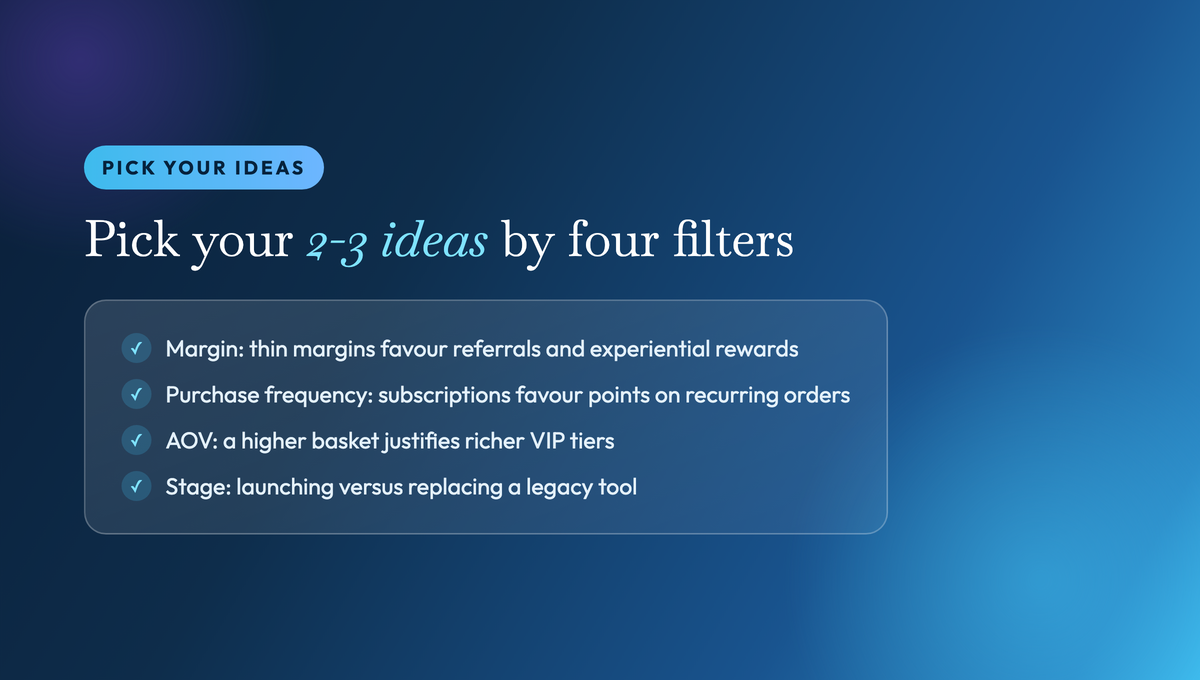
Don't launch all 14. A bloated programme confuses customers and tanks redemption, and redemption is the metric that actually correlates with repeat purchases. Ecommerce redemption rates vary by category, but industry estimates often sit around 20-30%, so your job is to make rewards easy enough that you beat the average. Yoggies, the Love Loyalty customer above, shows what a focused programme does: 97.3% participation, 82% redemption, and 66% of sales from members (Love Loyalty customer data).
Pick by four filters:
If I had to bet, I'd start with points-on-purchases, one word-of-mouth idea (referrals) and one belonging idea (tiers or community). Three done well beat 14 done badly. For the full walkthrough, start with how to set up a Shopify loyalty program.
One honest note before you build. Whichever ideas you choose, they live or die on two things: whether customers can see and redeem rewards where they shop, and whether it loads fast. If your points balance is buried behind a slow pop-up widget, redemption drops no matter how clever the mechanic. That's exactly why Love Loyalty surfaces points and redemption across 18 native app blocks, from the product page to the cart to the account page. In-cart redemption works on every plan and the balance shows at checkout (checkout redemption itself is Shopify Plus only). They're embedded theme blocks, not pop-ups, and everything is stored in Shopify metafields so it loads without API lag. It's also why most mechanics aren't locked behind enterprise pricing: points, in-cart redemption and referrals are on the Free plan (up to 150 orders/month), POS for in-store purchases comes in from the Professional plan at $12/month, and VIP tiers and paid memberships start on the Growth plan at $79/month. Every paid plan includes a 14-day free trial. Good idea, sure. But it only pays off if customers can actually see and redeem the reward.
Two honest knocks, while we're here. Love Loyalty is built exclusively for Shopify, so if you're on WooCommerce or BigCommerce, this isn't your tool, and that's fine. And it's a newer platform with a smaller community than the decade-old incumbents, so if you want years of third-party tutorials, that's a fair gap today. One thing it does remove from the switch: a done-for-you migration that imports your data from any loyalty app within 24 hours, including point balances and points for past actions.
If you're on Shopify, the next step is simple. Ready to see Love Loyalty in action with your store? Book a free demo today.
The highest-return ideas reward behaviour beyond the purchase: points for signups, social follows and referrals, VIP tiers, paid memberships and birthday rewards. Redeeming members buy back far more often, so prioritise ideas that are genuinely easy to redeem.
Two or three, not all of them. A focused programme beats a bloated one because redemption, the metric tied to repeat purchases, drops when customers are confused. Aim for the top of the 20-30% ecommerce redemption band (industry estimates vary by category) by keeping rewards simple and surfacing the balance in-cart.
Yes. The Free plan costs $0/month and covers up to 150 orders/month, with the points program, in-cart redemption, the referral program, full customisation and live chat support. It does not include POS, VIP tiers or paid memberships. Paid plans start at $12/month (Professional), which adds POS support for in-store purchases, and every paid plan comes with a 14-day free trial.
Yes, and they can be your best channel. Referrals are still the most trusted way to acquire a new customer, and a tiered structure (like HexClad's, where referring 3 friends earns a product worth around $199) rewards your biggest advocates the most.
Often yes. Paid members are markedly more likely to increase their spend than free-programme members (McKinsey research, 2020). Tomlinson's Pet Club shows it works at a small scale with a $10/year fee, as long as the perks are clearly worth more than the price.
Send them 3-5 days before the birthday with a 2-4 week redemption window. Offers that expire at midnight on the day see sharply lower redemption, so give people time to actually use it.
Points that apply to recurring orders. Olipop integrates points with Shopify subscriptions to reduce churn, and Care/of adds values-based redemptions like carbon-offsetting a shipment. Both fit health and supplement brands well.
Because customers only redeem what they can see. If points and redemption are buried behind a slow pop-up, redemption falls regardless of the offer. Love Loyalty puts rewards across 18 native app blocks (product page, cart, account and more), with in-cart redemption on every plan, and stores them in Shopify metafields so they load fast, which is what turns a good idea into repeat revenue.